The Importance of Material Fidelity in Injection Training
In medical education, the transition from theory to clinical application is a critical period. Students must develop muscle memory that allows them to perceive the subtle difference between resistance and penetration. This is why the specific materials are used in injection belly trainers are so closely scrutinized. If a trainer is too hard, the student may develop a heavy-handed technique; if it is too soft, they may not learn to properly stabilize the tissue.

Table of Contents
- The Importance of Material Fidelity in Injection Training
- The Primary Components: Silicone, PVC, and Polymers
- Internal Absorption Mechanics: The Role of Specialized Sponges
- Structural Integrity: Backing Pads and Protective Layers
- Featured Product: Belly Injection Model for Abdominal Injection Practice
- Psychological Impact: How Realism Reduces Injection Anxiety
- Longevity and Cleaning: Maintaining Synthetic Tissue
- Material Comparison Table
- Frequently Asked Questions
- References and Standards
Modern simulators utilize multi-layered designs to replicate the abdominal wall. The goal is to provide a high-fidelity experience that mimics the tension of human skin and the pliability of the underlying fat layer. By understanding what materials are used in injection belly trainers, educational institutions and home-care patients can make informed decisions about their training equipment.
The Primary Components: Silicone, PVC, and Polymers
The outermost layer of an injection trainer, the “skin,” is typically composed of medical-grade silicone or specialized soft PVC (Polyvinyl Chloride). These materials are used in injection belly trainers because they can be formulated to various “durometers” or levels of hardness.
Medical-Grade Silicone
Silicone is favored for its hypoallergenic properties and its uncanny ability to mimic the friction of human skin. When a needle is inserted into a high-quality silicone pad, it requires a realistic amount of force to break the surface tension. Furthermore, silicone has “self-healing” properties to a certain extent, meaning the puncture marks are less visible, allowing for hundreds of repeated uses.
Soft PVC and Thermoplastic Elastomers (TPE)
In some cost-effective models, TPE or PVC is used. These materials are used in injection belly trainers to provide a durable, tear-resistant surface. While slightly less realistic than silicone in terms of pore texture, they are incredibly robust for high-volume classroom settings where durability is the primary concern.
Internal Absorption Mechanics: The Role of Specialized Sponges
A unique challenge for an abdominal trainer is the management of injected fluids. Unlike a simple suturing pad, an injection trainer must be able to “take” the liquid. This is where the internal sponge materials come into play.
Internal sponge layers are essential materials used in injection belly trainers. These are usually open-cell polyurethane foams. The open-cell structure allows the liquid (usually water or a simulated saline solution) to be dispersed through the matrix rather than pooling in one spot. This mimics the way a subcutaneous injection disperses into the fatty tissue of the abdomen.
Drainage and Hygiene
High-end models feature removable sponges. Because these materials are used in injection belly trainers to absorb liquid, they must be easily cleaned and dried to prevent the growth of mold or bacteria. The ability to remove the sponge layer for drainage is a hallmark of a professional-grade training model.
Structural Integrity: Backing Pads and Protective Layers
Safety is a paramount concern, especially with wearable models. If a student or patient is wearing the device while practicing, there is a risk of a “needle-stick” injury if the needle passes through the trainer and into the wearer’s actual skin.
To mitigate this, rigid plastic backing plates or high-density protective pads are integral materials used in injection belly trainers. Usually made of high-impact polystyrene or reinforced ABS plastic, these plates act as an impenetrable barrier. This allows the user to practice with confidence, knowing that even a deep or poorly angled injection will be stopped safely before making contact with their body.
Featured Product: Belly Injection Model for Abdominal Injection Practice
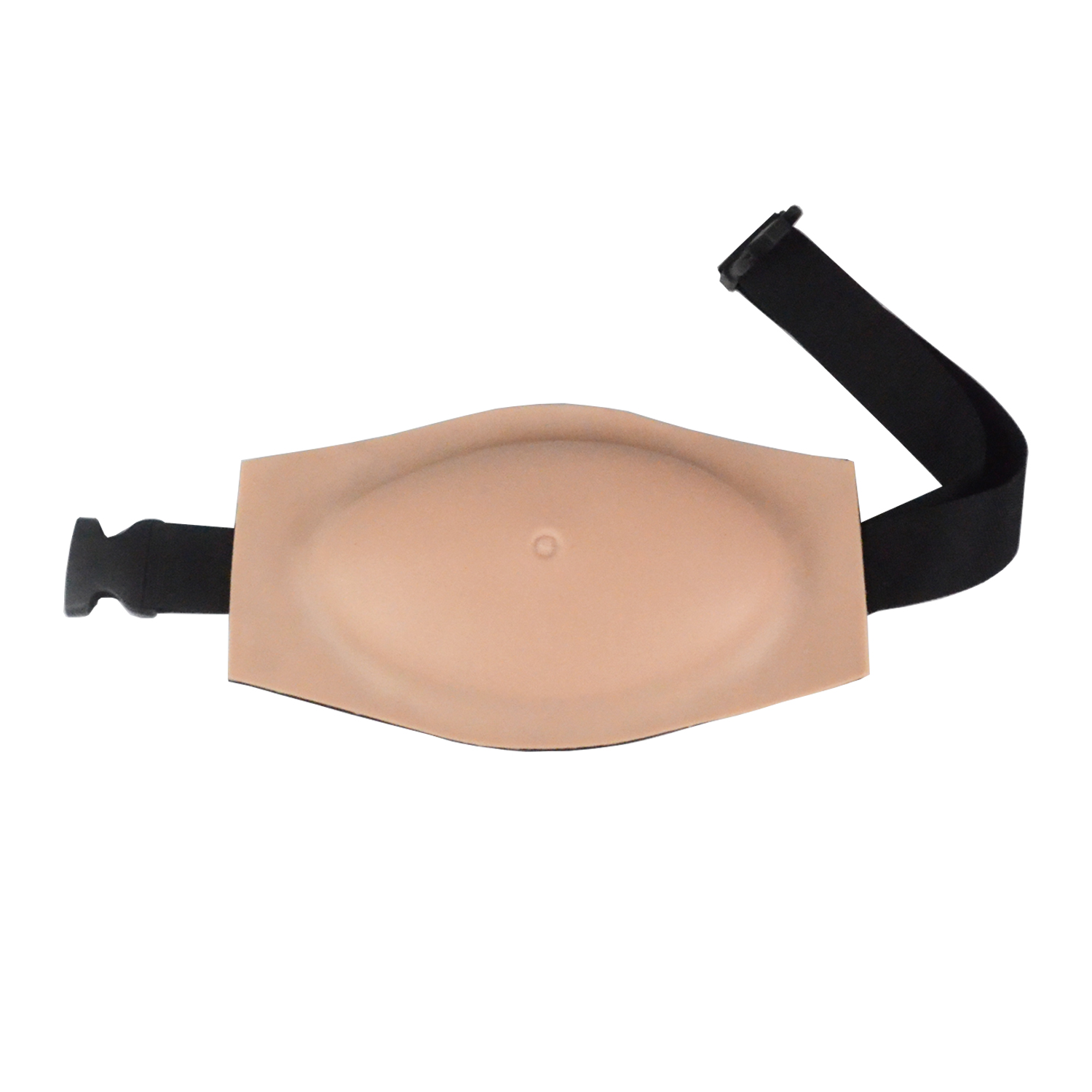
The Belly Injection Model – Subcutaneous Injection Training Pad is a state-of-the-art tool designed for both medical professionals and patients. Understanding the materials used in injection belly trainers is easy when examining this model’s high-fidelity design.
- Realistic Wearable Abdominal Injection Model: This soft, lifelike abdominal injection model can be worn to simulate real subcutaneous injection scenarios. Internal sponge absorbs injected liquid and can be easily removed for drainage and cleaning after repeated practice.
- Skill Development Before Patient Injection: Perfect your injection technique with this belly injection model before working with real patients. This realistic training model helps users identify proper injection sites, control needle angle and depth, and reduce anxiety associated with self-injection.
- Patient Education & Home Practice: Ideal for patients who require long-term self-injections, such as insulin or growth hormone. Provides a safe and effective way to practice at home, build confidence, and master proper injection techniques.
- Training for Caregivers and Medical Staff: Excellent educational tool for family members and healthcare providers. Perfect for home healthcare, diabetes management, or chronic disease care training programs.
- High-Fidelity Design: The abdominal pad’s thickness is perfect for subcutaneous injections. Comes with a backing protective pad to prevent needle punctures, making it ideal for medical students, nurses, and anyone who requires frequent abdominal injections.
Psychological Impact: How Realism Reduces Injection Anxiety
The materials are used in injection belly trainers not just for physical simulation, but for psychological preparation. Self-injection is a significant hurdle for patients with diabetes or hormonal imbalances. The tactile experience of the “squish” and “pop” of the needle entering the synthetic tissue helps desensitize the patient to the act.
Using lifelike materials creates a sense of familiarity. When a patient moves from the Belly Injection Model for Abdominal Injection Practice to their own abdomen, the sensation is strikingly similar. This reduces the “fright factor,” leading to better adherence to medication schedules and fewer errors in needle depth.
Longevity and Cleaning: Maintaining Synthetic Tissue
Because the materials are used in injection belly trainers to withstand repeated punctures, they require specific care to maximize their lifespan.
- Cleaning the Surface: Silicone and PVC surfaces should be wiped down with mild soap and water or 70% isopropyl alcohol after use to remove oils and simulated fluids.
- Drying the Sponge: After practicing liquid injections, the internal sponge must be removed and squeezed out. It is best to let it air dry completely before reassembling the unit to ensure no moisture is trapped against the backing plate.
- Needle Size: To preserve the skin-like material, it is recommended to use 27G to 31G needles, which are standard for subcutaneous injections. Using larger needles may cause premature tearing of the silicone.
Material Comparison Table
| Component | Common Material | Purpose in Trainer | Benefit |
|---|---|---|---|
| Outer Skin Layer | Medical-Grade Silicone | Mimics epidermis/dermis | Realistic tactile feedback and self-healing punctures. |
| Subcutaneous Layer | Open-cell Polyurethane Foam | Absorbs injected liquid | Realistic liquid dispersion and removable for hygiene. |
| Protective Barrier | ABS or Polystyrene Plastic | Prevents needle-through | Ensures safety for wearable simulation. |
| Fasteners | Elastic Nylon / Velcro | Secures device to waist | Allows for wearable, hands-free practice. |
Frequently Asked Questions
Can I use real insulin with these trainers?
While possible, it is not recommended due to the cost and the potential for residue buildup. Distilled water or specialized simulated injection liquid is the preferred choice for preserving the materials used in injection belly trainers.
How many injections can the pad handle?
A high-quality silicone pad like the Belly Injection Model for Abdominal Injection Practice can typically handle 500 to 1,000 injections if small gauge needles are used and the puncture sites are distributed across the surface.
Are the materials hypoallergenic?
Most professional trainers use medical-grade silicone which is naturally hypoallergenic. However, users with severe latex or specific polymer allergies should check the manufacturer specifications for the backing and straps.
References and Standards
- National Center for Biotechnology Information (NCBI) – Studies on Medical Simulation Materials
- ISO 10993: Biological Evaluation of Medical Devices – Guidelines for Skin Contact Materials
In conclusion, the science behind what materials are used in injection belly trainers is a blend of chemistry, engineering, and pedagogical design. By utilizing medical-grade silicone, absorption-ready foams, and rigid safety barriers, manufacturers have created tools like the Belly Injection Model for Abdominal Injection Practice that effectively mimic the human body. Whether you are a nursing student or a patient learning to manage a chronic condition, these materials provide the necessary realism to build confidence and ensure safety.