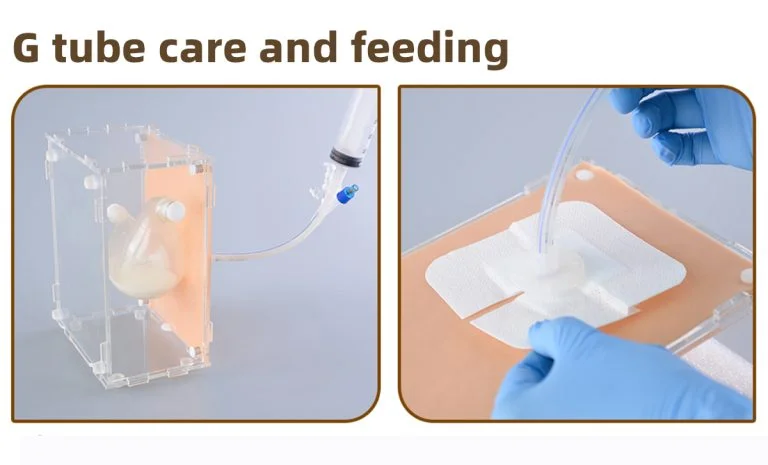
A gastrostomy tube — most people just call it a G tube — is a soft feeding tube placed directly into the stomach through a small opening in the abdominal wall. When someone cannot safely eat or drink enough by mouth, a G tube delivers nutrition, fluids, and medication straight to where the body can use them. This guide explains what a gastrostomy tube is, why it is needed, the different types (including PEG, surgical, and the low-profile “Mickey button”), and how a G tube compares with NG and GJ tubes — in plain language for patients, families, caregivers, and students.
Important: This article is educational. Decisions about whether a gastrostomy tube is needed, which type to use, and how to feed and care for it are made by your medical team for each individual patient.
What Is a Gastrostomy Tube?
It helps to separate two words that are often blurred together:
- A gastrostomy is the opening — a surgically created passage, called a stoma, that runs from the skin of the upper-left abdomen directly into the stomach.
- The gastrostomy tube (G tube) is the device — the flexible tube that sits in that opening and stays in place so food and medicine can be delivered into the stomach.
So “What’s a gastrostomy tube?” has a simple answer: it is a feeding tube that bypasses the mouth, throat, and esophagus and goes straight into the stomach. Because it enters through the abdomen rather than the nose or mouth, it is comfortable enough to stay in place for months or years — which is why it is the standard choice when tube feeding is expected to be long-term.
A gastrostomy tube does not change how the stomach digests food. The stomach and intestines work normally; the tube simply provides another route to get nutrition in.
Why Is a Gastrostomy Tube Needed? (Indications)
A gastrostomy tube is usually recommended when a person cannot take in enough nutrition by mouth safely or reliably for an extended period — generally longer than about four to six weeks. Common reasons include:
- Swallowing problems (dysphagia) after a stroke, brain injury, or in progressive neurological conditions such as ALS, Parkinson’s disease, or advanced dementia.
- Neurological impairment in children and adults — for example cerebral palsy — that makes safe oral feeding difficult.
- Head and neck cancers (and their treatment), where the mouth, throat, or esophagus is affected.
- Inability to meet nutritional needs by mouth, such as severe failure to thrive, prolonged poor appetite during serious illness, or high nutritional demands that eating alone cannot keep up with.
- A high risk of aspiration (food or liquid going into the lungs), where feeding by mouth is unsafe.
- Stomach decompression or “venting” — less commonly, a gastrostomy tube is used to drain the stomach (for example, in certain bowel obstructions) rather than to feed.
Choosing a feeding tube is a significant decision. The medical team weighs the expected duration of tube feeding, the patient’s overall condition, and their goals of care before recommending a gastrostomy.
Types of Gastrostomy Tubes and How They Are Placed
People often ask whether a “PEG tube” and a “gastrostomy tube” are the same thing. The short answer: PEG is one type of gastrostomy tube — the most common one — defined by how it is placed. Gastrostomy tubes are grouped by their placement method and by their external design.
By placement method
- PEG (Percutaneous Endoscopic Gastrostomy). The most common method. A gastroenterologist passes an endoscope (a thin camera) down into the stomach and uses it to guide the tube into place through a small incision in the abdomen — without open surgery. “Percutaneous” means through the skin; “endoscopic” means guided by the scope.
- Surgical gastrostomy. Placed in an operating room, either through a small open incision (a classic technique is the Stamm gastrostomy) or laparoscopically (keyhole surgery). This route is chosen when an endoscope cannot be passed safely, or when the patient is already having another abdominal operation.
- Radiologic gastrostomy (RIG / PRG). Placed by an interventional radiologist using real-time X-ray (fluoroscopy) to guide the tube, without an endoscope or open surgery.
All three create the same end result — a stoma into the stomach holding a feeding tube. The best method depends on the patient’s anatomy and condition.
By external design
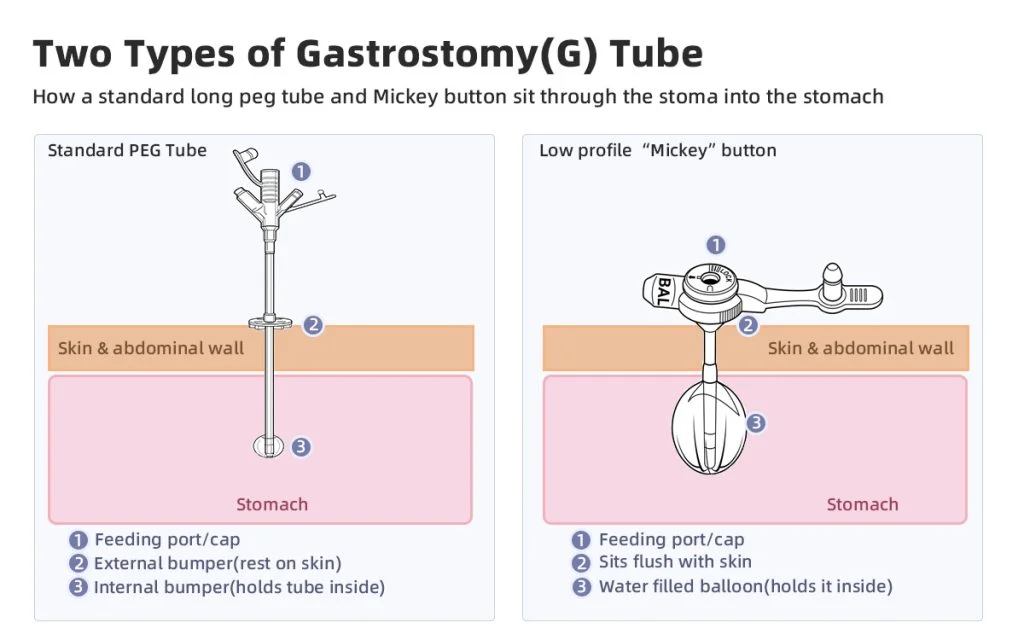
- Standard (long) tube. A length of tube that extends outside the body, with a cap and feeding ports. Most PEG tubes start out this way. It is held inside either by an internal bumper (a soft non-balloon disc) or by a water-filled balloon.
- Low-profile button (the “Mickey button”). A short device that sits almost flush with the skin, with a small port that opens only when an extension set is connected for feeding. Brand names such as MIC-KEY are widely known, which is why many people call any low-profile tube a “Mickey button.” Buttons are popular because they are discreet, harder to pull out accidentally, and easy to live with day to day — common for children and active patients. A low-profile button is usually fitted after the stoma tract has matured (often a couple of months after the first tube), not at the very first placement.
Gastrostomy Tube vs NG Tube vs GJ Tube
A gastrostomy tube is one of several feeding-tube options. The two it is most often compared with are the nasogastric (NG) tube and the gastrojejunostomy (GJ) tube. Here is how they differ:
| Gastrostomy (G) tube | Nasogastric (NG) tube | Gastrojejunostomy (GJ) tube | |
|---|---|---|---|
| Where it enters | Through the abdominal wall into the stomach | Through the nose, down to the stomach | Through the abdominal wall; the tip continues past the stomach into the jejunum (small intestine) |
| Where feed is delivered | Into the stomach | Into the stomach | Into the small intestine (and often a separate port into the stomach) |
| Best for | Long-term feeding (more than ~4–6 weeks) | Short-term feeding (days to a few weeks) | Patients who cannot tolerate stomach feeding — e.g. severe reflux, high aspiration risk, or gastroparesis |
| Visible on the face? | No — under clothing on the abdomen | Yes — taped to the nose/cheek | No — on the abdomen |
| Placement | Minor procedure (PEG, surgical, or radiologic) | Inserted at the bedside, no procedure | Usually placed/converted with imaging guidance |
G tube vs NG tube — the key difference is time. An NG tube is quick to place and needs no procedure, so it is ideal for short-term support. But it is uncomfortable, easy to dislodge, and irritating to the nose and throat over time. When feeding is expected to last beyond about four to six weeks, a gastrostomy tube is generally preferred because it is more comfortable, more secure, and not visible on the face.
G tube vs GJ tube — the key difference is where the feed lands. A standard G tube feeds into the stomach. A GJ tube extends past the stomach so feed is delivered directly into the jejunum, which helps patients who have severe reflux, who aspirate stomach contents, or whose stomach empties poorly (gastroparesis). Many GJ tubes also keep a gastric port so the stomach can be vented or drained at the same time.
Who Decides — and What Living With a G Tube Is Like
The decision to place a gastrostomy tube is made by a team — typically including the treating physician, a gastroenterologist or surgeon, a dietitian, and the patient and family. For many people, a G tube is a temporary bridge while they recover and relearn to eat; for others it is a long-term or permanent source of nutrition. In either case, most patients and caregivers learn to manage feeds and basic care confidently, and many people with a G tube can still enjoy some food or drink by mouth if their team says it is safe.
Day-to-day life with a gastrostomy tube centers on a few routines: giving feeds and medications, keeping the skin around the stoma clean and dry, and watching for common issues. Those care steps — feeding, site care, replacing the tube, and troubleshooting problems like leaking, blockage, or granulation tissue — are covered in our companion guide, PEG Tube Placement & G-Tube Care.
Frequently Asked Questions (FAQ)
Can you move around and stay active with a gastrostomy tube?
Yes. Once the stoma has healed, most people walk, work, travel, and exercise normally with a G tube. The tube is tucked under clothing, and a low-profile button is especially discreet. Securing any external tube length to the skin or with a tube-holder belt keeps it from snagging during activity. Contact sports or swimming should be cleared with your care team first.
Can you shower or bathe with a PEG or G tube?
Generally yes, once the site has fully healed (your team will tell you when — often after the first week or two). Showering is usually fine; the stoma can simply be patted dry afterward. Soaking in baths, hot tubs, or pools may be restricted while the site is new or if there is any irritation, so check with your team about timing and whether to cover the site.
What should you do if a gastrostomy tube falls out?
Treat it as urgent. The stoma tract can begin to close within hours, so do not wait. Cover the opening with clean gauze and contact your medical team or go to urgent/emergency care right away — sooner if the tube was placed recently (within the first several weeks), as a fresh tract is not yet established. Do not attempt to push the tube back in yourself unless your team has specifically trained you to do so. We cover dislodged and accidentally removed tubes in more detail in our care guide.
Is a gastrostomy tube permanent, or can it be removed later?
It depends on the reason it was placed. For some people a G tube is temporary — a bridge while they recover or relearn to swallow — and it is removed once they can meet their nutrition needs by mouth again. For others it is long-term or permanent. After removal, the small stoma usually closes on its own within days to a couple of weeks.
Does having a gastrostomy tube hurt?
Placement is done under sedation or anesthesia, so it is not painful at the time. The site is often sore for a few days as it heals. Once healed, a well-cared-for G tube is generally comfortable and feeding through it does not hurt. New or worsening pain, redness, or swelling at the site should always be reported to your care team.
Can you still eat and drink by mouth with a G tube?
Often, yes — if your medical team confirms swallowing is safe. A gastrostomy tube is added to support nutrition, not always to replace eating entirely. How much a person can take by mouth depends on the condition that led to the tube; some enjoy tastes and small amounts, others rely on the tube for all nutrition.
How long does a gastrostomy tube last before it needs changing?
It varies by tube type. Balloon-type tubes and low-profile buttons are typically changed every few months, while bumper-held PEG tubes can stay in place much longer and are usually changed during a planned procedure. Your team will set the schedule and show caregivers what to watch for. Replacement and troubleshooting are covered in our companion care guide.
Sources
- MedlinePlus (U.S. National Library of Medicine) — Gastrostomy feeding tube (G tube)
- StatPearls / NCBI Bookshelf — Percutaneous Endoscopic Gastrostomy (PEG)
- American Society for Gastrointestinal Endoscopy (ASGE) — Understanding PEG tubes
- ASPEN (American Society for Parenteral and Enteral Nutrition) — Enteral nutrition and feeding access
- Cleveland Clinic — Feeding tube (gastrostomy) patient information
This article is for general education only and is not a substitute for individualized medical advice. Decisions about feeding tubes should always be made with a qualified healthcare professional who knows the patient’s situation.
🩺 For Students, Nurses & Training Teams
Building confidence with stoma care and tube handling is far easier on a model first. Our Gastrostomy Care Training Model lets students and nurses practise PEG/G-tube handling, feeding setup, and stoma-site care before working with real patients.