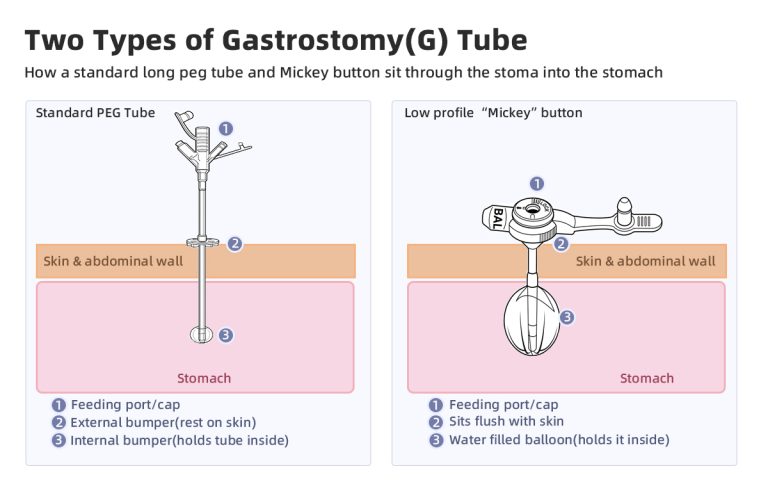
Once a gastrostomy tube is in place, most of the day-to-day work is care: feeding through it, keeping the stoma site healthy, and knowing what to do when something goes wrong. This guide walks through how a PEG tube is placed, how to care for the stoma and feed safely, how the tube is replaced, and how to troubleshoot the common problems — blockages, leaking, granulation tissue, and a tube that comes out. It is the practical companion to our overview, What Is a Gastrostomy (G) Tube?
Important: This article is educational. Feeding volumes, formulas, flush amounts, and the care plan are set by your medical team for each patient. Always follow their specific instructions over any general guidance here.
How a PEG Tube Is Placed
The most common way to create a gastrostomy is PEG — percutaneous endoscopic gastrostomy — a short procedure done with sedation, usually taking 15–30 minutes. In simple terms:
- An endoscope (a thin camera) is passed through the mouth into the stomach, which is then inflated with air so it sits against the abdominal wall.
- The endoscope’s light is used to find a safe spot. After numbing and a small skin incision, a needle and guide wire are passed into the stomach.
- The feeding tube is drawn into position so that an internal bumper (or, in some tubes, a balloon) holds it snugly inside the stomach while an external bumper rests on the skin.
When an endoscope cannot be used, a gastrostomy may instead be placed surgically (open or laparoscopic) or by interventional radiology under X-ray guidance. All routes leave the same result: a tube through the abdominal wall into the stomach. (For the differences between tube types and how a G tube compares with NG and GJ tubes, see our overview guide.)
After placement the new tract needs time to heal — usually a few weeks — before the tube is first changed or swapped for a low-profile button.
Caring for the Stoma Site
Good site care prevents most complications. Once your team says the site has healed enough to clean (often after the first day or two), a simple daily routine keeps it healthy:
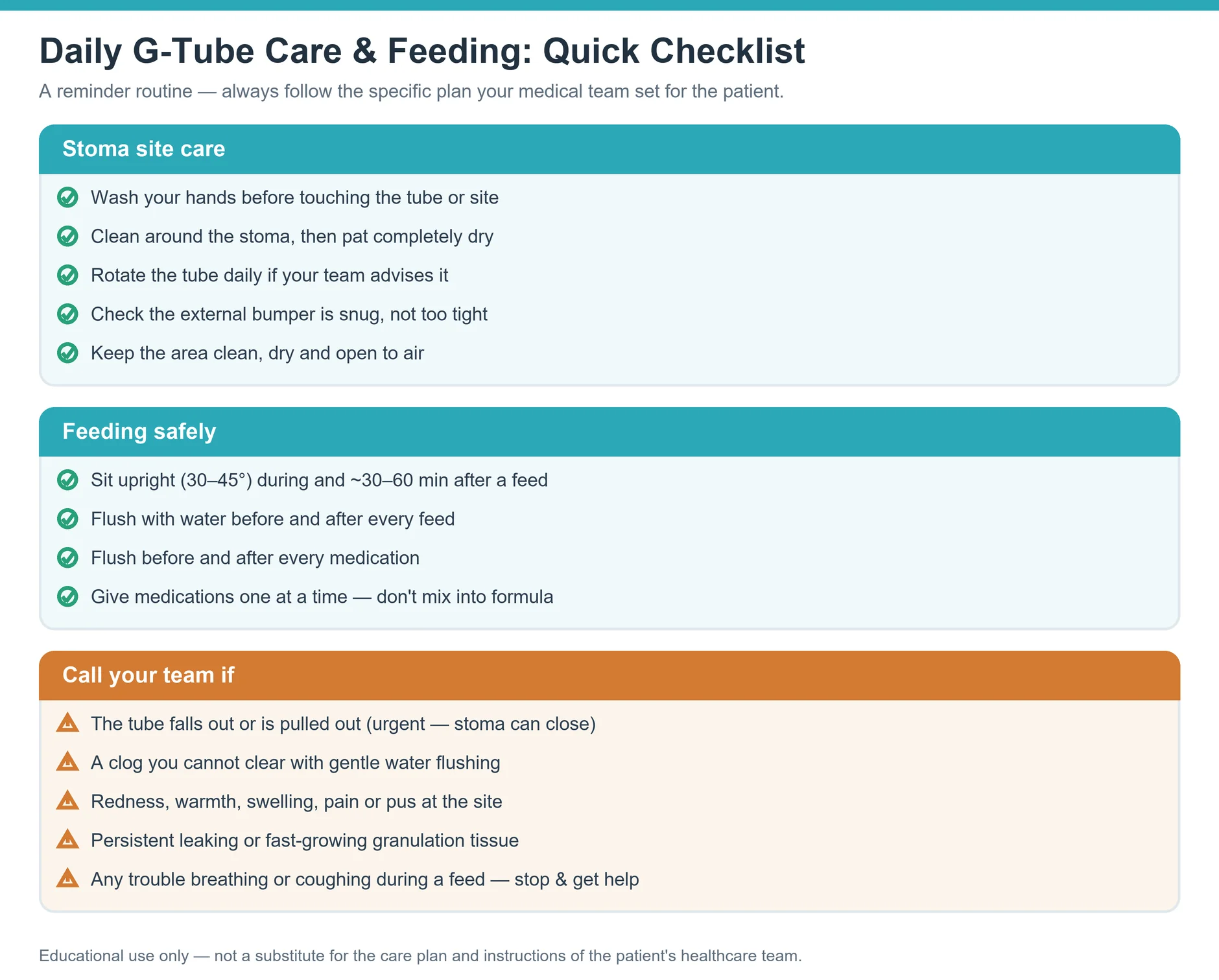
- Wash your hands before touching the tube or site.
- Clean around the stoma with mild soap and water (or as your team directs), using a cotton swab in a circular motion outward. Rinse and pat completely dry — moisture is what irritates skin.
- Rotate the tube a quarter to half turn daily if your team advises it (for tubes with a bumper), which helps prevent the tube sticking to the tract. Do not rotate a freshly placed surgical tube unless told to.
- Check the external bumper sits snugly but not too tight — you should be able to slide it slightly. A bumper pressed too tightly into the skin can cause sores.
- Keep the area open to air when possible; only use a dressing if your team recommends one, and change it if it becomes damp.
- Look at the skin each day for redness, swelling, leaking, or unusual discharge so problems are caught early.
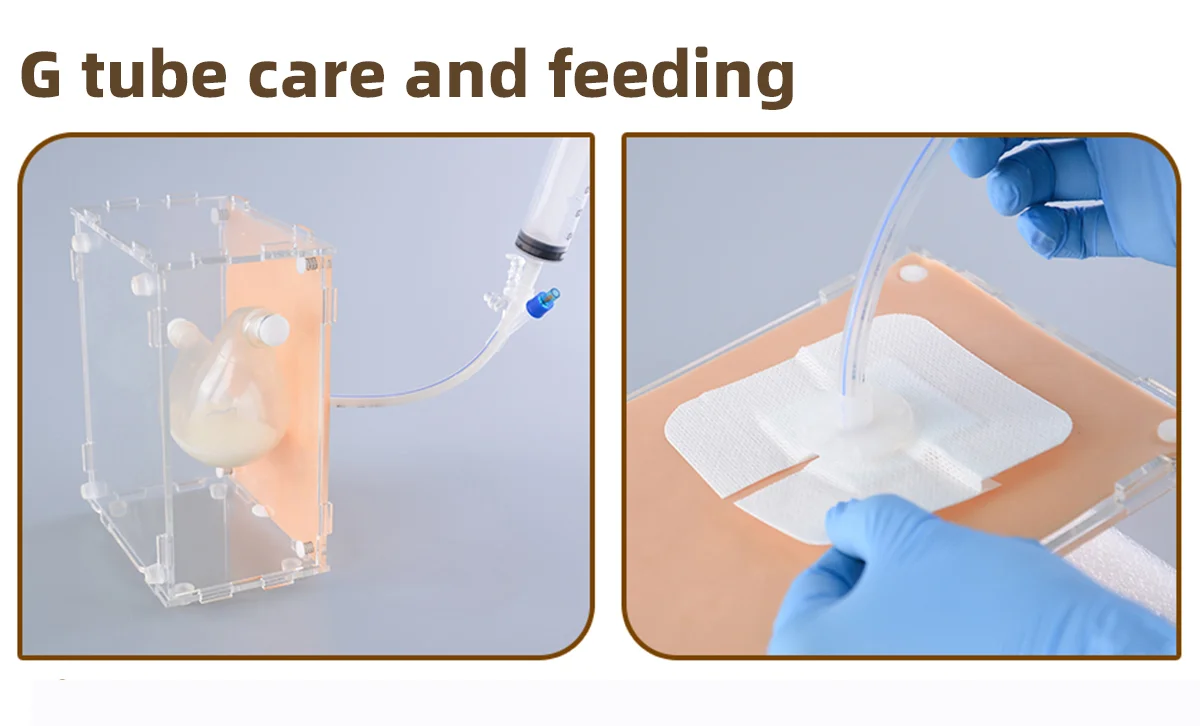
Feeding Through a Gastrostomy Tube
Feeds and medications go in through the tube’s port. Your dietitian prescribes the formula, the amount, and the method.
How to Check PEG Tube Placement Before Feeding
Before each feed or medication, do a quick safety check using the baseline your care team documented after placement:
- Check the external length or tube marking. It should match its usual position at the skin or external fixation device.
- Inspect the tube and stoma. Make sure the tube is secure and not kinked, cracked, partly pulled out, or pushed farther in. Look for new pain, swelling, bleeding, or leaking.
- Confirm the connection. Use the correct feeding port or extension set and make sure the clamp and cap work normally.
- Stop if anything has changed. Do not start the feed if the external length is different, the tube may have moved, flushing causes new pain or resistance, or its position is uncertain. Contact the medical team and follow their confirmation protocol. Do not rely on the old air-bolus or “whoosh” test.
Initial placement and a newly replaced tube require the verification method specified by the treating service; depending on the tube and situation, that may include aspirate testing or imaging.
PEG Tube Feeding Steps
- Wash your hands, gather the prescribed formula and supplies, and complete the placement and site check above.
- Sit upright with the head and chest raised at least 30-45 degrees.
- Flush with the amount of water prescribed by the care team.
- Give the formula by the prescribed bolus, gravity, or pump method and at the prescribed rate.
- Flush again after the feed, close the port, and remain upright for the time specified in the care plan.
The three common feeding methods are:
| Method | How it works | Often used for |
|---|---|---|
| Bolus | A set amount given over a few minutes with a syringe, several times a day | People who tolerate larger feeds, more freedom between meals |
| Gravity | Formula flows from a bag/syringe over 20–60 minutes | A gentler pace than bolus |
| Pump | A feeding pump delivers slowly over hours, sometimes overnight | Sensitive stomachs, continuous feeding, or higher volumes |
A few rules make feeding safe and keep the tube working:
- Sit upright (head and chest raised at least 30–45°) during the feed and for about 30–60 minutes after, to reduce reflux and the risk of aspiration.
- Flush the tube with water before and after every feed and every medication — typically about 30 mL (your team sets the amount). Flushing is the single best habit for preventing clogs.
- Give medications correctly: use liquid forms when available; if crushing is allowed, crush to a fine powder, dissolve well, and flush between each medication. Never add medication directly into formula unless told to.
- Check tolerance: report repeated vomiting, bloating, cramping, or diarrhea to your team — the rate or formula may need adjusting.
Some patients also use the tube for venting — opening it to release trapped gas or stomach contents for comfort. Your team will show you how if it applies.
Granulation Tissue Around the Stoma
One of the most common issues with a G tube is granulation tissue — soft, moist, beefy-red tissue that builds up around the stoma. It can be lumpy, bleed easily when touched, and weep clear or yellowish fluid. It is the body over-healing around the tube, and while it is usually not dangerous, it can be uncomfortable and cause leaking.
What helps:
- Keep the site clean and dry, and make sure the tube is stabilized so it isn’t constantly tugging or rubbing — friction is the main driver of granulation tissue.
- Check the external bumper isn’t too loose, which lets the tube move around more.
- Tell your medical team. They may prescribe treatments (such as a topical steroid or other therapies) or, for stubborn tissue, treat it in the clinic. Don’t apply over-the-counter remedies to it without guidance.
Troubleshooting Common G-Tube Problems
- Clogged or blocked tube: use a 60 mL enteral syringe, unless the care team or device instructions specify otherwise, and gently flush with warm water using a push-pause motion. Smaller syringes can create excessive pressure and may rupture the tube. Never force it with a thin object, which can damage or puncture the tube. Prevent clogs by flushing before/after every use and giving meds properly. If it won’t clear, contact your team.
- Leaking around the tube: small amounts can come from granulation tissue, a balloon that needs its water checked/topped up (balloon tubes only), or a stoma that has stretched. Keep the skin clean and dry and report persistent leaking — never tape the tube tighter as a fix.
- The tube falls out or is pulled out (dislodged): this is time-sensitive — the stoma can begin closing within hours. Cover the opening with clean gauze and contact your team or seek urgent care right away, sooner if the tube is new (within the first several weeks). Do not push it back in unless your team has trained you to do so.
- Balloon won’t stay inflated (balloon tubes): if the tube keeps slipping out, the balloon may have failed and the tube likely needs replacing — contact your team.
- Redness, warmth, pain, swelling, or foul discharge: these can signal infection at the site and should be reported promptly.
Replacing a Gastrostomy Tube
A G tube does not stay in forever. Balloon-type tubes and low-profile buttons are usually changed every few months, while bumper-held PEG tubes can last much longer and are typically changed during a planned endoscopic or clinic procedure. Once the tract is well established, many balloon tubes and buttons can be changed at home or in clinic by trained caregivers; a non-balloon (bumper) tube generally needs a clinician. Your team decides the schedule and who changes it. If a tube is ever damaged, blocked beyond clearing, or comes out, it should be replaced promptly so the stoma does not close.
When a tube is no longer needed, it is removed and the small stoma is usually left to close on its own, which typically happens within days to a couple of weeks.
When to Call Your Medical Team
Contact your provider promptly if you notice:
- The tube falls out or is pulled out (urgent — the stoma can close).
- A clog you cannot clear, or you cannot give a feed or medication.
- Signs of infection at the site: spreading redness, warmth, swelling, pain, or pus.
- Persistent leaking, significant bleeding, or rapidly growing granulation tissue.
- Repeated vomiting, severe bloating, or signs the feeds are not tolerated.
- Any breathing difficulty, choking, or coughing during or after feeding — stop the feed and seek help.
Frequently Asked Questions (FAQ)
How do you unclog a feeding tube at home?
Use a 60 mL enteral syringe, unless the care team or device instructions specify otherwise, and try warm water with a gentle push-and-pause motion. Do not use a smaller syringe to create more pressure; excessive pressure can damage or rupture the tube. Avoid carbonated drinks or juice (they can worsen clogs) and never poke a wire or skewer down the tube. If gentle flushing doesn’t clear it, call your team rather than forcing it.
How often should you flush a G tube?
Flush with water before and after every feed and every medication, and as your team directs in between — even on days without feeds, tubes are usually flushed to stay patent. Routine flushing is the best way to prevent blockages.
Can you give all medications through a gastrostomy tube?
Many medications can, but not all. Liquid forms are best. Some pills must not be crushed (extended-release or enteric-coated ones), so always check with a pharmacist or your team. Give and flush each medication separately rather than mixing them.
Is bleeding from granulation tissue dangerous?
A small amount of spotting when granulation tissue is bumped is common and usually not serious. Persistent or heavier bleeding, rapid growth, or signs of infection should be checked by your team.
Can you travel with a G tube?
Yes. With planning — packing enough supplies and formula, a spare tube or kit if your team advises, and keeping feeds on schedule — people travel and fly with a gastrostomy tube routinely. Ask your team for a travel letter and supply plan before a trip.
How long after placement can the tube be changed to a button?
Usually after the tract has matured — often around 8–12 weeks, though your team decides based on healing. A low-profile button is popular once the site is stable because it is discreet and harder to dislodge.
What should be kept on hand at home?
Typically: syringes for feeding and flushing, the prescribed formula, clean gauze, the supplies your team recommends for site care, and — if advised — a spare tube or replacement kit in case the tube comes out. Your team will give you a supply list.
Sources
- MedlinePlus (U.S. National Library of Medicine) — Gastrostomy tube care and feeding
- StatPearls / NCBI Bookshelf — Percutaneous Endoscopic Gastrostomy (PEG) and tube care
- ASPEN (American Society for Parenteral and Enteral Nutrition) — Enteral nutrition administration
- American Society for Gastrointestinal Endoscopy (ASGE) — Understanding PEG tubes
- Cleveland Clinic / NHS — Feeding tube (gastrostomy) home-care information
This article is for general education only and is not a substitute for individualized medical advice. Feeding plans, flush volumes, medication administration, and stoma care should follow the instructions of the healthcare team who knows the patient.
🩺 For Students, Nurses & Training Teams
Practising stoma care, flushing, and feeding setup on a model first builds confidence before working with patients. Our Gastrostomy Care Training Model lets students and nurses rehearse PEG/G-tube handling, feeding, and site care safely.