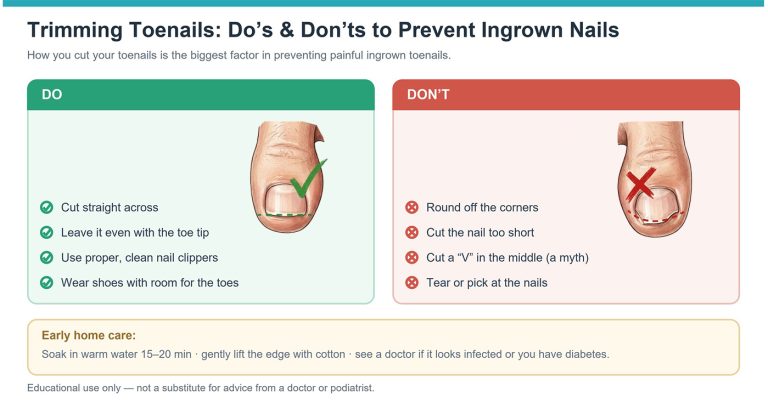
When an ingrown toenail keeps coming back, becomes infected, or no longer responds to home care, a doctor or podiatrist can fix it with a quick in-office procedure. This guide explains when ingrown toenail removal is needed, what the procedure actually involves (partial nail avulsion, total avulsion, and matrixectomy), what recovery is like, and how to stop it returning. It’s the clinical companion to our guide on ingrown toenail causes, symptoms, and home treatment.
Important: This article is educational and describes procedures performed by a healthcare professional. It is not a guide to removing a nail yourself — attempting that risks serious infection. If you have diabetes or poor circulation, see a professional at the first sign of an ingrown toenail.
When Is Ingrown Toenail Removal Needed?
Most early ingrown toenails settle with home care. A doctor or podiatrist may recommend a procedure when:
- The ingrown toenail is infected (pus, spreading redness, throbbing pain) and conservative care isn’t enough.
- It keeps coming back despite proper trimming and footwear.
- There is excess granulation tissue (overgrown, bleeding tissue) along the nail fold.
- The nail is very curved, thick, or deformed, so the edge will keep digging in.
- The person has diabetes or poor circulation, where even a minor ingrown toenail needs prompt professional treatment.
How an Ingrown Toenail Is Removed: The Procedure
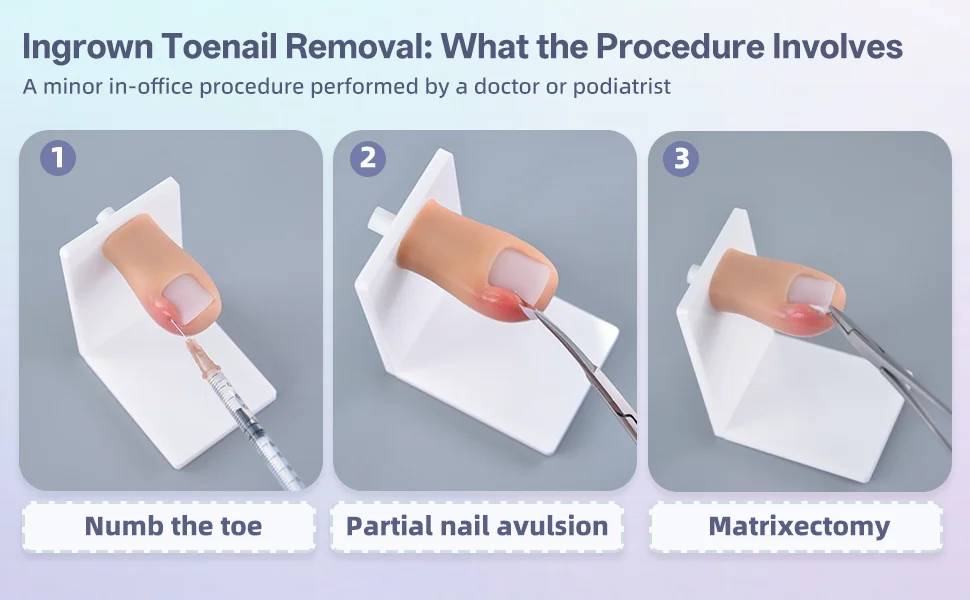
Removal is a minor procedure usually done right in the clinic, start to finish in well under an hour. Here’s what to expect:
- Numbing (a digital block). The toe is cleaned and a local anaesthetic is injected at its base, so the procedure itself is painless. This is the only part most people feel.
- Partial nail avulsion — the most common option. The doctor removes only the ingrowing strip along one side of the nail, leaving most of the nail intact. The toe looks almost normal afterward and this resolves the great majority of cases.
- Total nail avulsion. Occasionally the whole nail is removed — for example when the entire nail is severely deformed or thickened. A new nail slowly regrows over several months.
- Matrixectomy (to stop regrowth). To stop a recurrent ingrown toenail from coming back, the doctor treats the nail matrix — the growth cells at the base of the removed strip — either chemically (commonly with phenol) or surgically. This permanently narrows or removes that portion of nail so the edge can’t grow back in.
- Dressing. The toe is covered with an antibiotic ointment and a sterile dressing.
The choice between these depends on how severe and how recurrent the problem is — your clinician will explain which is right for your toe.
Treating Excess Granulation Tissue (“Proud Flesh”)
Long-standing or infected ingrown toenails often grow excess granulation tissue — soft, red, easily bleeding tissue (sometimes called “proud flesh”) that bulges over the nail fold. It’s the body’s overgrown healing response to the constant irritation of the nail edge digging in.
Because this tissue is a reaction to the offending nail spike, the key to clearing it is removing that underlying cause. During an ingrown toenail removal the clinician usually deals with the granulation tissue in the same visit:
- Removing the ingrowing nail edge that triggered the overgrowth, and
- Trimming or curetting the granulation tissue, or treating smaller amounts with silver nitrate — a chemical applicator that cauterises and shrinks it.
Once the nail edge is gone — especially when a matrixectomy stops it regrowing — the granulation tissue typically settles and the nail fold returns to normal over a few weeks. Trying to burn or cut this tissue off at home is not safe: it bleeds readily and can hide a deeper infection, so leave it to a clinician.
Recovery and Aftercare
Recovery from a partial nail avulsion is usually straightforward. Your team will give you specific instructions, but typical aftercare looks like this:
- Keep the foot elevated for the first day or two to limit throbbing and swelling.
- Pain is usually mild once the anaesthetic wears off and is controlled with over-the-counter pain relief; the toe may be tender for a few days.
- Soak and redress as directed — often daily warm-water soaks starting the day after, then a clean dressing and a little antibiotic ointment.
- Wear open or roomy shoes for the first week or two so nothing presses on the toe.
- Get back to activity gradually — most people return to desk work within a day or two and to exercise once the toe is comfortable.
- The wound generally heals over about two to six weeks. After a total nail removal, a new nail takes several months to grow back.
Contact your clinician if you notice increasing pain, spreading redness, pus, or a fever after the procedure — these can signal infection.
Possible Complications and Risks
Ingrown toenail removal is a low-risk, routine procedure, but as with any minor surgery there are a few things to be aware of:
- Infection. Uncommon with proper aftercare, but increasing pain, spreading redness, pus, or fever means you should contact your clinician promptly.
- Recurrence. A nail edge removed without a matrixectomy can grow back in. A leftover sliver of nail (a spicule) can also regrow and may need a second, smaller procedure.
- Slow healing and drainage. A phenol matrixectomy in particular tends to weep clear fluid and can take several weeks to fully heal. This is expected rather than a true complication, but it’s longer than many people assume.
- A narrower or slightly different-looking nail. After a matrixectomy the treated portion is permanently gone, so the nail is narrower. Most people find this a worthwhile trade for ending the pain.
- Delayed healing in higher-risk people. Those with diabetes, poor circulation, or nerve problems heal more slowly and need close professional follow-up.
Serious complications are rare. Choosing an experienced clinician and following the aftercare plan keeps the risk low.
Will It Come Back? Recurrence and Prevention
A simple nail removal without treating the matrix has a meaningful chance of the ingrown toenail returning. Adding a matrixectomy (phenol or surgical) substantially lowers that risk, which is why it’s often recommended for recurrent cases.
Alongside the procedure, the same habits that prevent ingrown toenails in the first place protect the result — trimming straight across, not too short, and wearing roomy shoes. We cover those in detail in our ingrown toenail causes and home-care guide.
What Does Ingrown Toenail Removal Cost?
Cost varies widely by country, setting, and whether a matrixectomy is included, and insurance often covers medically necessary treatment. Because it ranges so much, ask the clinic for a quote and check your coverage before the appointment rather than relying on a single figure online.
Frequently Asked Questions (FAQ)
Does ingrown toenail removal hurt?
The numbing injection at the base of the toe stings briefly, but the removal itself is painless because the toe is fully anaesthetised. Afterward the toe is usually only mildly sore for a few days and manageable with over-the-counter pain relief.
Will my toenail grow back after removal?
It depends on the procedure. After a partial or total avulsion without a matrixectomy, the nail regrows over several months. If a matrixectomy was done, that treated portion is meant not to grow back — that’s how it prevents recurrence.
How long does it take to recover?
Most people are back to normal daily activities within a day or two and return to exercise once the toe is comfortable. The site itself typically heals over about two to six weeks, depending on the procedure.
Can you walk right after the procedure?
Yes — most people can walk out of the clinic, though you’ll want flat, open or roomy footwear and should keep the foot elevated when resting that first day or two.
Is removing the nail permanent?
A partial avulsion only removes a strip and the rest of the nail stays. The result is only permanent if a matrixectomy is done to stop that portion regrowing — otherwise the nail grows back.
How do I look after the toe at home afterward?
Follow your clinician’s plan: keep it elevated early on, do warm-water soaks and clean dressing changes as directed, use a little antibiotic ointment if advised, wear roomy shoes, and watch for signs of infection.
Sources
- American Academy of Family Physicians (AAFP) — Ingrown toenail removal and management
- NHS — Ingrown toenail (treatment and surgery)
- StatPearls / NCBI Bookshelf — Ingrown Toenails (Onychocryptosis) and nail avulsion
- Mayo Clinic — Ingrown toenails: diagnosis and treatment
- American College of Foot and Ankle Surgeons (ACFAS) — Ingrown toenail surgery
This article is for general education only and describes procedures carried out by qualified clinicians. It is not instructions for self-treatment. People with diabetes, poor circulation, or nerve problems should seek professional care for any ingrown toenail.
🩺 For Students, Podiatry & Training Teams
Nail-removal technique is a skill best rehearsed on a model before treating patients. Our Ingrown Toenail Removal Practice Kit and Ingrown Toenail Trainer with Replaceable Toes & Nails let students practise partial nail avulsion and toe care repeatedly with replaceable nails.