Those lines that appear when you raise your eyebrows, frown, or smile are called dynamic expression lines, and they come from the repeated pull of the muscles under your skin. Botox — a purified form of botulinum toxin type A — works by gently relaxing those specific muscles so the overlying lines soften. The key to a natural result is knowing exactly which muscle creates which line, and where Botox is injected to treat it. This guide maps the main Botox injection sites on the face, explains what each area treats, and covers the very different injection pattern used for chronic migraines.
Important: This article is educational. Botox is a prescription treatment that should only be planned and administered by a qualified, licensed medical professional after an in-person assessment.
Why Expression Lines Form: The Muscles Behind Them
There are two kinds of facial lines. Dynamic lines appear only when you make an expression — they are caused by muscle movement. Static lines are visible even at rest, as skin loses collagen and elasticity over time. Botox treats dynamic lines by relaxing the muscle; deeper static lines are usually addressed with dermal fillers instead.
Three muscle groups create most upper-face expression lines:
- Frontalis (the broad forehead muscle) — lifts the eyebrows and creates the horizontal forehead lines.
- Corrugator and procerus (between the eyebrows) — pull the brows together and down, creating the vertical glabellar or “frown” lines (the “11” lines).
- Orbicularis oculi (the ring of muscle around each eye) — creates the fan of crow’s feet at the outer corners when you smile or squint.
How Botox Works
Botox temporarily blocks the nerve signal (acetylcholine) that tells a muscle to contract. With the muscle relaxed, it stops creasing the skin above it, and the dynamic line softens. Results begin to appear in about 3–7 days, reach their full effect in roughly two weeks, and typically last 3–4 months before the muscle gradually regains movement and a repeat treatment is needed.
“Botox” is the best-known brand, but it is one of several botulinum toxin type A products that also include Dysport, Xeomin, and Jeuveau. They work in the same way, but their units are not interchangeable — only your injector should convert dosing between products.
Botox Injection Sites: A Face Diagram
Each treatment area targets the specific muscle that creates the line. The most common cosmetic Botox injection sites are outlined below by treatment area; the number of injection points and the dose are always tailored to the individual by the injector.
- Forehead lines (frontalis): a row of points spread across the forehead. Injectors stay a safe distance above the brow, because placing Botox too low can let the brow drop.
- Frown / “11” lines (glabella): several points into the corrugator and procerus muscles between the brows. This was the first area FDA-approved for cosmetic Botox.
- Crow’s feet (orbicularis oculi): a small cluster of points outside each eye, kept lateral to the bony orbital rim.
- Other common areas: “bunny lines” on the nose, a “lip flip” of the upper lip, and brow-lift points — all considered additional or off-label uses chosen case by case.
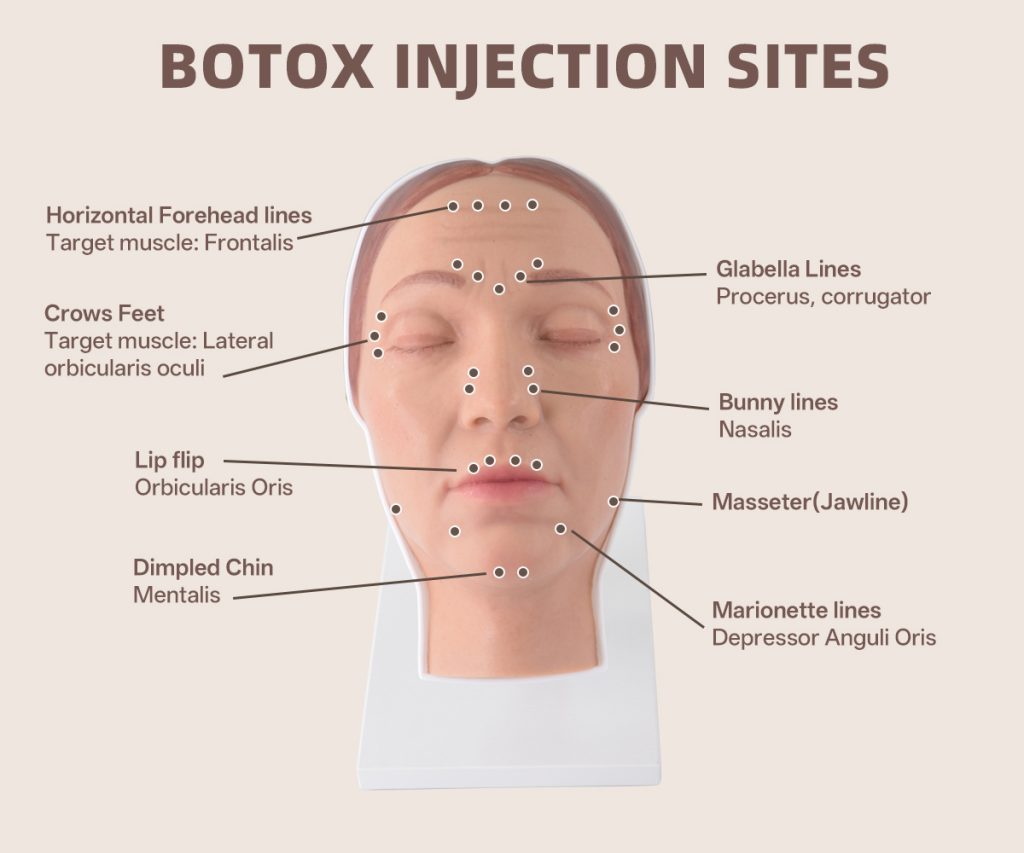
Why a map matters: the face is full of muscles that do different jobs, and a few millimeters can be the difference between a refreshed look and a dropped brow or an uneven smile. That is why injection-site planning belongs in trained hands.
Botox for Crow’s Feet
Crow’s feet are one of the most popular Botox areas. The injections relax the outer fibers of the orbicularis oculi, the muscle that bunches the skin at the corner of the eye when you smile. Because this muscle is thin and close to the surface, the injections are shallow and placed well to the side of the eye. Treatment softens the lines while still allowing a natural smile — over-treating here is what causes a “frozen” look, which is why conservative, well-placed dosing matters.
Botox for Migraines: A Different Set of Injection Sites
Botox is also FDA-approved to prevent chronic migraine — defined as having 15 or more headache days per month. The migraine protocol is very different from cosmetic treatment: it uses a fixed, standardized pattern of 31 injections across seven muscle groups, not a few wrinkle-specific points.
- Areas injected: the forehead, temples, back of the head, neck, and shoulders.
- Schedule: treatments are repeated about every 12 weeks.
- Onset: relief usually starts in one to two weeks, and the first two cycles may give less relief than later ones.
- Who gives it: typically a neurologist or headache specialist — not a cosmetic visit.
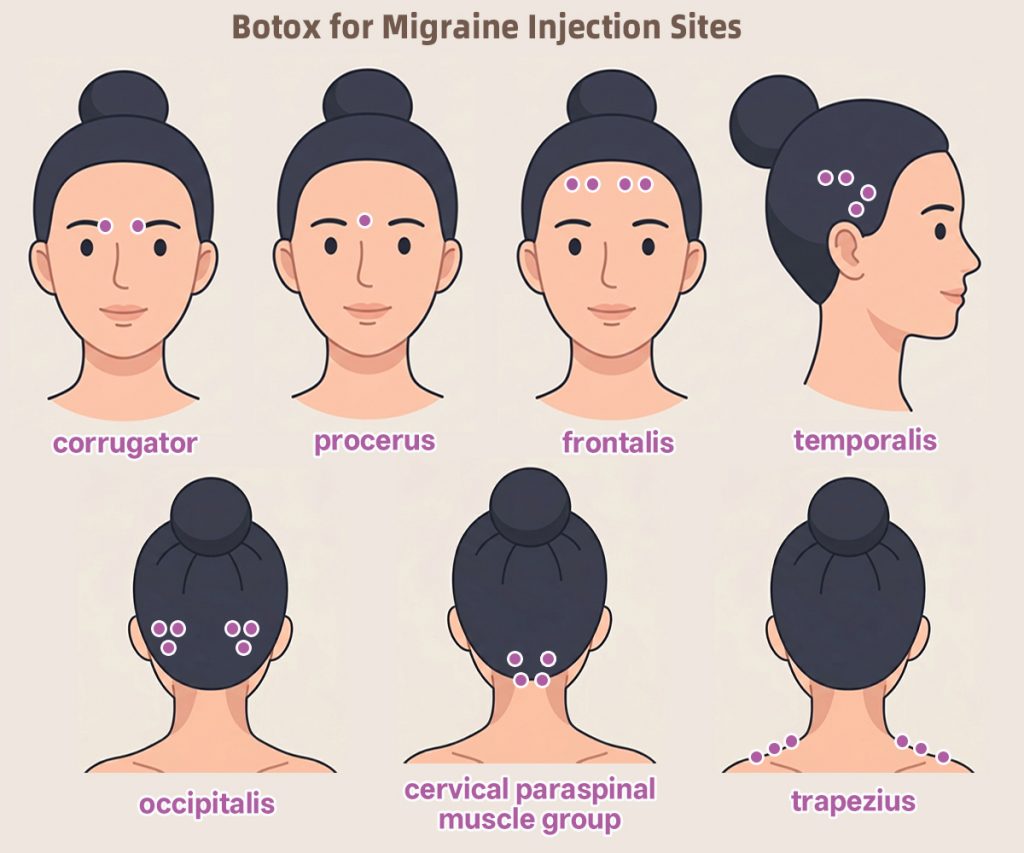
Migraine Botox relaxes muscles around pain-signaling nerves to reduce how often headaches happen; it is a preventive treatment, not a treatment for a headache already in progress.
Beyond Wrinkles: Other Medical Uses of Botox
The same muscle-relaxing action makes botulinum toxin useful for a range of medical conditions, many of them FDA-approved. These therapeutic uses are handled by the relevant specialist and use their own injection sites and dosing:
- Excessive sweating (hyperhidrosis): injections into the underarms (or palms) block the nerves that activate sweat glands.
- Jaw clenching and teeth grinding (masseter): relaxing the strong masseter muscle can ease TMJ-related pain and is sometimes used to slim a square jawline.
- Muscle and eye disorders: Botox has long been used for conditions such as cervical dystonia, blepharospasm (eyelid spasm), and certain types of muscle spasticity.
This breadth is a reminder that Botox is a genuine prescription medicine, not just a cosmetic product — which is exactly why injection sites and dosing should be planned by a trained professional.
What to Expect: Results, Safety, and Side Effects
- The appointment is quick — cosmetic sessions take only minutes, and most people return to normal activity right away.
- Common side effects are mild: small bruises, redness, or a temporary headache. With migraine treatment, neck pain or brief flu-like symptoms can occur.
- Less common is a temporary droopy eyelid or brow (ptosis) if the product spreads to a nearby muscle — usually the result of placement and dose, and it resolves as the effect wears off.
- Who should avoid it: people who are pregnant or breastfeeding, or who have certain neuromuscular conditions, should not have Botox. Always disclose your full history.
The single biggest factor in a safe, natural result is the injector. Choose a board-certified dermatologist, plastic surgeon, or appropriately trained medical professional who understands facial anatomy.
Before and After Your Botox Treatment
A few simple steps help you get the best result and lower the small risk of bruising:
- Before: tell your injector about all medications and supplements. Blood thinners, fish oil, and alcohol can increase bruising, so your provider may advise pausing them — only on their guidance.
- Right after: stay upright for about four hours and avoid rubbing or massaging the treated areas, so the product stays exactly where it was placed.
- The first day: skip strenuous exercise, saunas, and hot yoga, which can encourage the product to spread.
- Follow-up: many injectors offer a two-week check to fine-tune the result if needed.
Frequently Asked Questions (FAQ)
How long does Botox last?
Cosmetic results typically last 3–4 months. As movement returns, lines gradually reappear and a repeat treatment maintains the effect. Migraine treatments are repeated about every 12 weeks.
Does getting Botox hurt?
The needles are very fine, so most people feel only a quick pinch. No anesthesia is usually needed, and the whole cosmetic appointment takes just a few minutes.
What’s the difference between Botox and dermal fillers?
Botox relaxes muscles to soften dynamic expression lines. Fillers add volume to plump static lines, lips, or cheeks. They solve different problems and are often used together — see our companion guide on facial fillers and fat transfer.
Will Botox make my face look frozen?
A “frozen” look comes from over-treating or poor placement. Skilled, conservative dosing softens lines while keeping natural movement and expression.
How soon will I see results?
Cosmetic effects begin in 3–7 days and peak around two weeks. For migraines, relief usually starts within one to two weeks.
Can I have Botox and fillers at the same time?
Yes — they treat different problems and are often combined in one plan (Botox for dynamic lines, filler for volume). Your provider will sequence and place them so the results work together.
How much Botox will I need?
It varies with the area, your muscle strength, and your goals. The injector decides the number of units and injection points for each muscle — there is no single “right” amount that fits everyone, which is why a personalized assessment matters.
Sources
- American Academy of Dermatology (AAD) — Botulinum toxin therapy
- American Society of Plastic Surgeons (ASPS) — Botulinum toxin (Botox)
- Cleveland Clinic — Botox for Migraines
- U.S. FDA — OnabotulinumtoxinA prescribing information
Medical disclaimer: This article is for general educational purposes only and is not medical advice. Botox is a prescription medicine; its suitability, injection sites, and dosing must be determined by a qualified, licensed medical professional after an individual assessment. Always consult your doctor about your specific situation.
🩺 For Aesthetic Injection Training
Mastering safe injection technique starts on a model, not a patient. For Botox practice specifically, the Facial Injection Training Head with Muscles, Arteries & Nerves is a half-anatomy head that maps the muscles, arteries, and nerves in areas such as the glabella, temples, and perioral region. Medtac’s Clear Facial Injection Model shows the arteries, veins, and nerves of the face — ideal for rehearsing accurate, safe needle placement — and the Facial Injection Training Model lets trainees practice across all the treatment areas above. For rehearsing injection angle and depth where the needle can be watched through the material itself, the Clear Facial Injection Mannequin Head is a transparent full head that also supports thread lift practice.