The cardinal movements of labor, also called the mechanism of labor or the seven cardinal steps of labor, are the position changes a baby’s head and body make to pass through the bony pelvis in a normal head-first birth. Students often memorize the list and still can’t picture it. This guide explains what happens at each step, why it happens, and how to show it with a fetal doll and pelvis so the sequence makes sense.
In a normal vertex (head-first) birth, the seven cardinal movements are engagement, descent, flexion, internal rotation, extension, restitution and external rotation, and expulsion. These movements overlap rather than happening one at a time. Descent continues through almost the whole process, so treat this order as a teaching sequence, not a strict timeline. The sections below explain each movement and how to show it on a model.
Why the Baby Has to Turn at All
The pelvis and the baby’s head are both wider in one direction than the other, and those directions change on the way down.
- At the pelvic inlet, the widest diameter runs side to side (transverse). StatPearls gives about 13 cm for the transverse diameter, compared with about 11.5 to 12 cm for the front-to-back obstetric conjugate.
- The baby’s head is longest front to back, and the shoulders are widest side to side.
So the head enters sideways, where the inlet has the most room. Lower down it turns front to back, and the shoulders follow the same logic at their own level. Clinicians describe labor as an interaction of power (contractions and pushing), passenger (the baby), and passage (the pelvis). The cardinal movements are how the passenger adapts to the passage.
Teaching tip: Before you start the sequence, hold the pelvis up and have students find the widest direction at the inlet and at the outlet. Once they see that the widest direction changes, the rotations stop looking arbitrary.
The 7 Cardinal Movements, One by One
1. Engagement
Engagement means the biparietal diameter, the widest side-to-side measurement of the head, has passed through the plane of the pelvic inlet. The head usually enters in a transverse position, with the baby facing one of the mother’s sides. This often happens before true labor begins.
On the model: Place the head at the inlet with the face toward one side of the pelvis. Show that the head fits best across the inlet, not front to back.
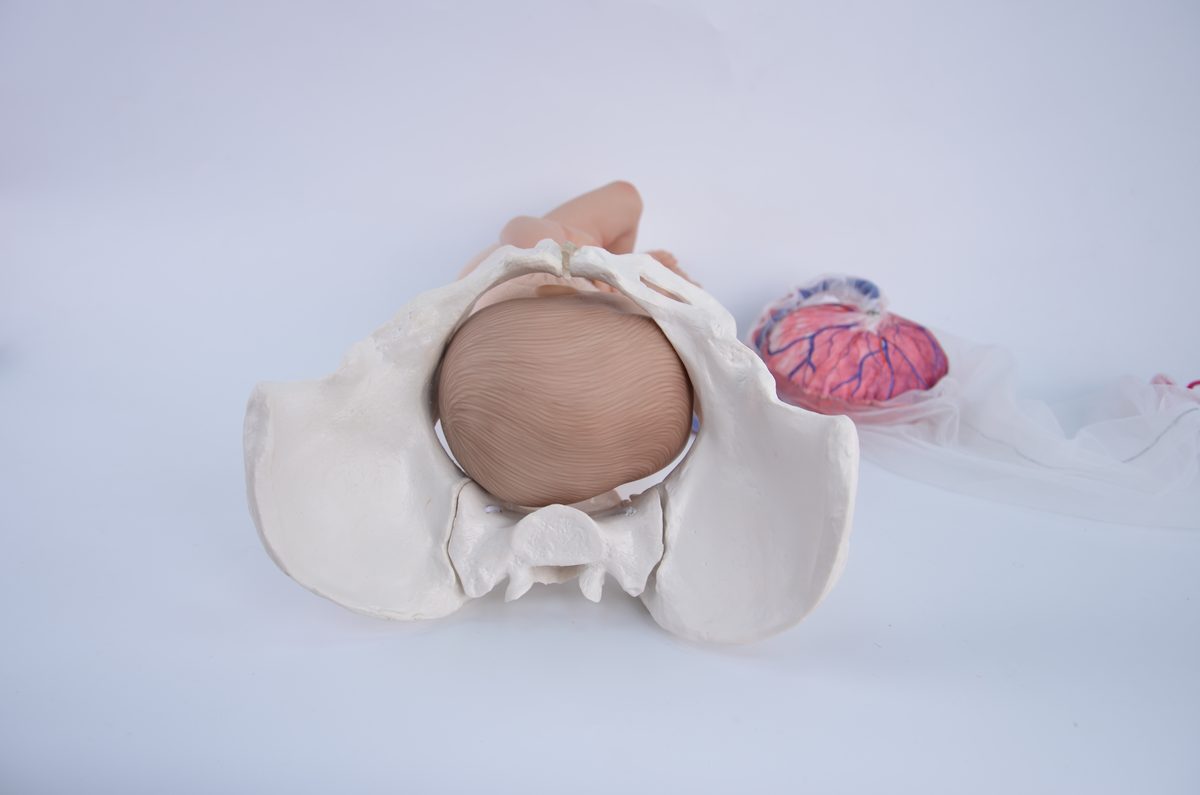
Engagement, viewed from below: the long axis of the head runs side to side across the pelvic inlet.
2. Descent
Descent is the baby’s downward progress through the pelvis. It is driven by contractions and, later, by maternal pushing. Descent is not a single moment. It runs underneath all the other movements, which is one reason textbooks place it at different points in the list.
On the model: Move the doll slowly downward and keep it moving during every later step. Say out loud that descent continues while the head flexes and rotates.
3. Flexion
As the head meets resistance from the pelvic walls and the pelvic floor, the chin is pushed toward the chest. Flexion matters because it changes which diameter leads. A well-flexed head presents the suboccipitobregmatic diameter, about 9.5 cm. A head that stays less flexed presents a longer diameter, such as the occipitofrontal diameter at about 11.5 cm.
On the model: Show the same head twice, once tucked and once in a neutral position. Ask students which one they would want leading through a tight space. That comparison also sets up later lessons on face and brow presentations, which happen when flexion is incomplete or absent.
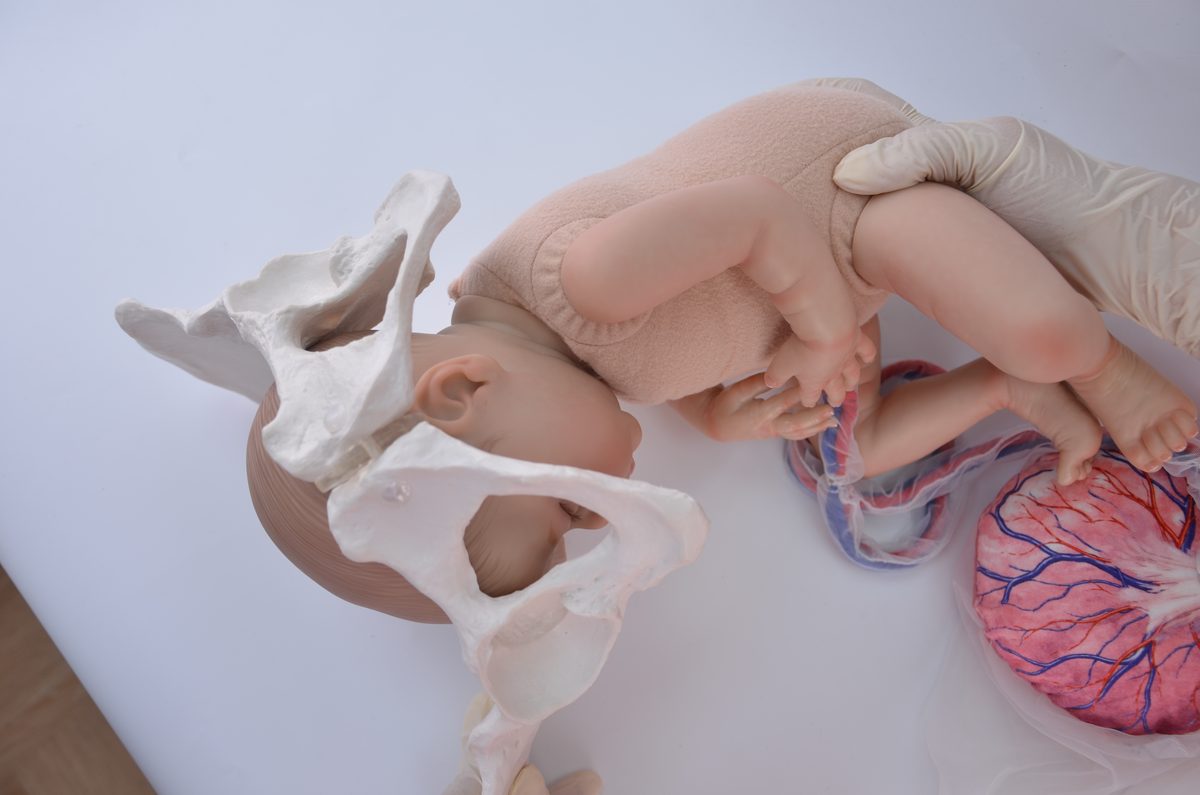
Flexion: the chin is tucked toward the chest as the head moves down through the pelvis.
4. Internal Rotation
In the mid-pelvis, the head turns from its transverse position to a front-to-back position. In the most common pattern, the occiput (back of the head) rotates toward the front of the pelvis, under the pubic bone, so the baby ends up facing the mother’s back. This is the occiput anterior position. The rotation also sets the shoulders across the wider transverse diameter higher up.
Internal rotation is where the side-to-side and front-to-back logic from the section above comes together. It is also where things can go differently: the head may turn so the occiput faces the mother’s back instead (occiput posterior), or it may not finish turning.
On the model: Rotate only the head while the shoulders stay transverse. Students should see the neck twist slightly. Pointing out that twist now makes restitution easy to explain later.
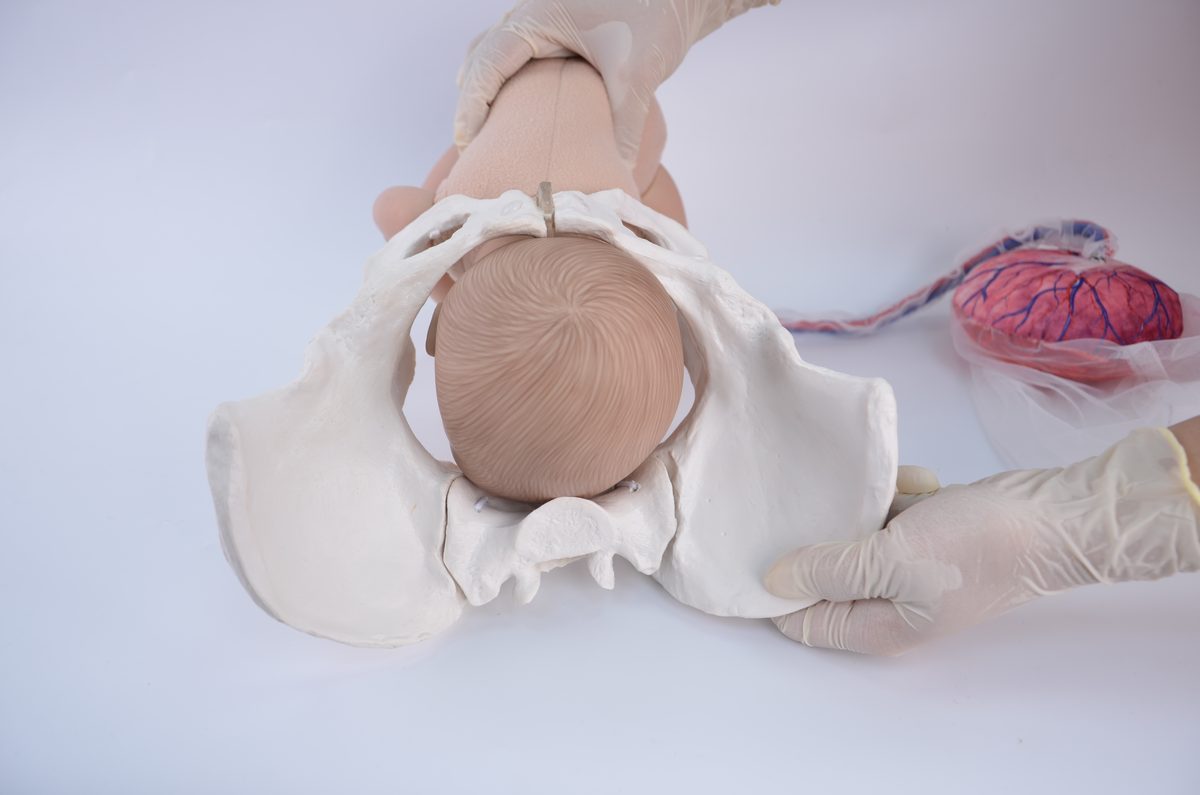
Internal rotation, viewed from below: the long axis of the head now runs front to back. An ear shows at the side, and the back of the head faces the pubic bone.
5. Extension
The occiput slips under the pubic bone, which acts as a pivot. The birth canal curves forward at the outlet, so the head can no longer move straight down. It extends (the chin lifts away from the chest), and the rest of the head is born as it moves up and out.
On the model: Tuck the occiput under the pubic arch and roll the head upward around that point. Students often push the doll straight down here. Show that the direction changes to follow the curve of the outlet.
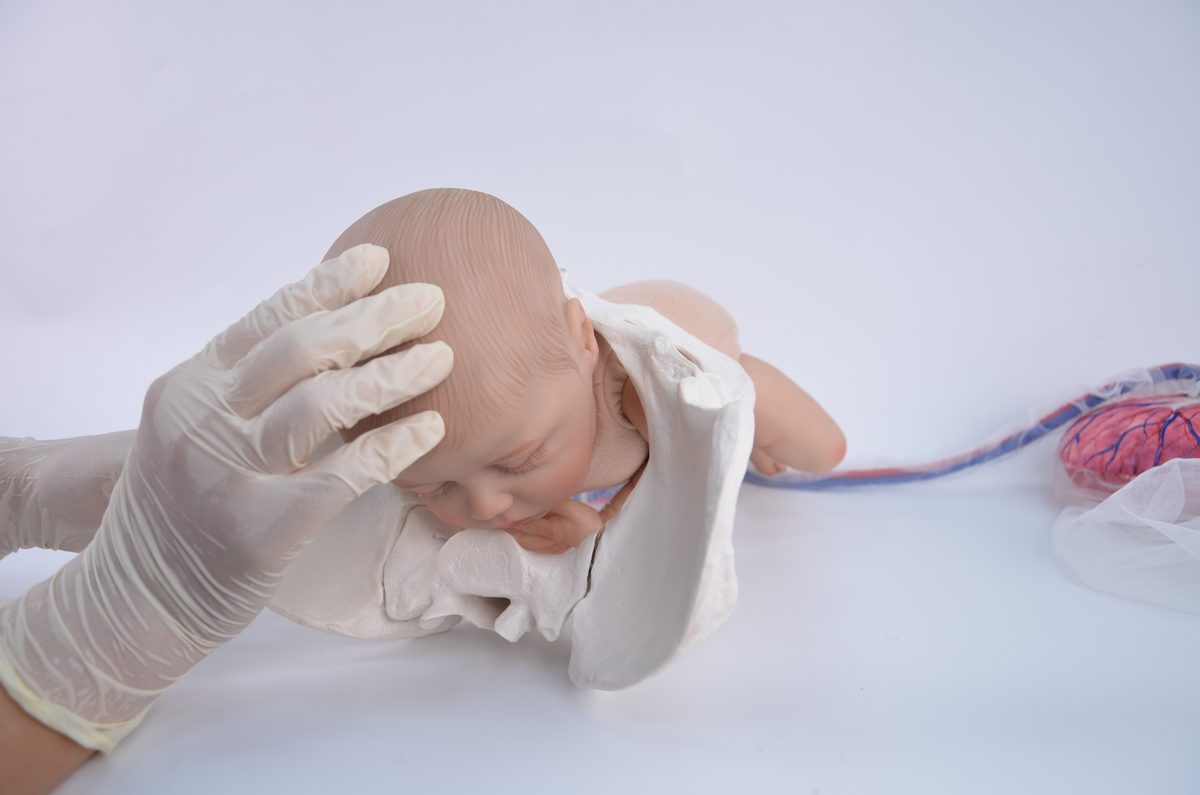
Extension: the head pivots under the pubic bone and lifts up and out of the pelvis.
6. Restitution and External Rotation
Once the head is born, it is free of the pelvis. It untwists back into line with the shoulders, which is restitution. The shoulders then rotate inside the pelvis to a front-to-back position so they can pass through the outlet. The head, now outside, turns further with them, which is external rotation. After external rotation, the baby’s face points toward one of the mother’s thighs.
Some sources count these as one movement and some as two, and some leave out expulsion. That is why you will see lists of six, seven, or eight cardinal movements.
On the model: Let the head swing back into line with the body first. Then turn the shoulders inside the pelvis and let the head follow. Doing the two turns separately is what makes the difference clear.
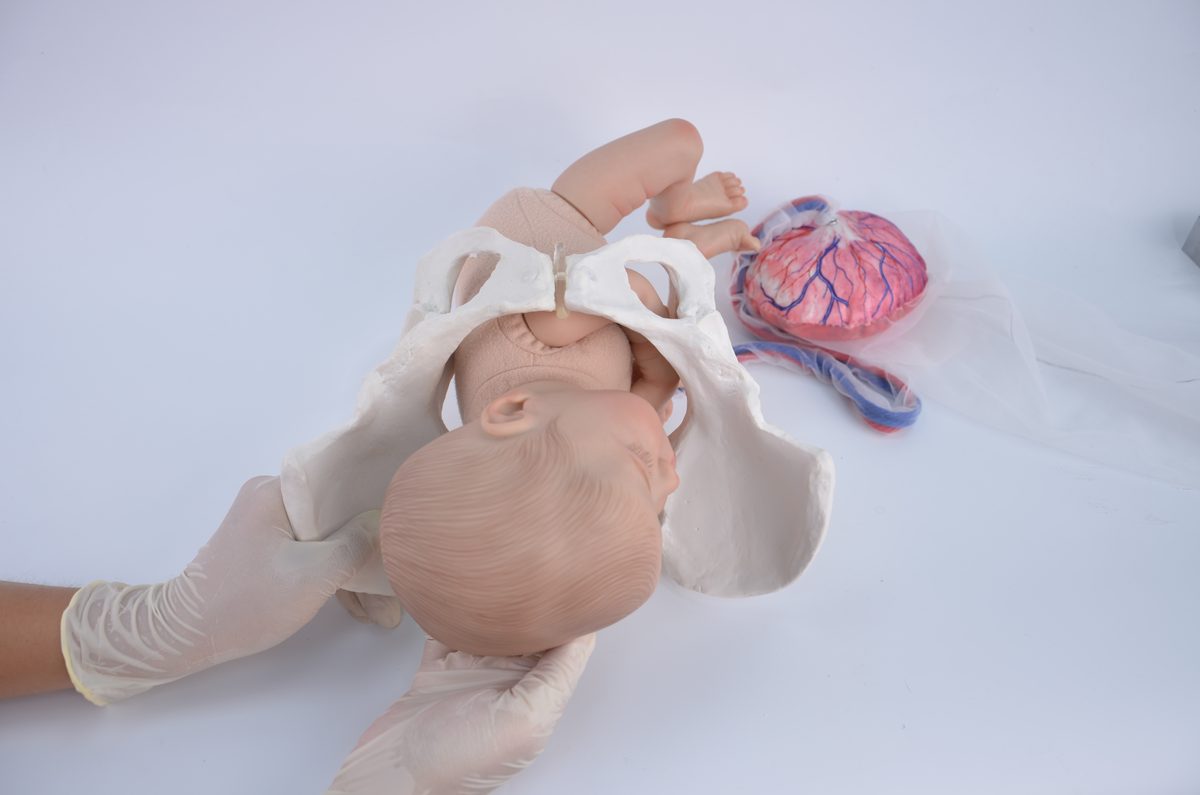
Restitution and external rotation: once born, the head turns so the face points toward one of the mother's thighs.
7. Expulsion
The anterior shoulder is born under the pubic bone, followed by the posterior shoulder. The rest of the body then follows with little resistance. The second stage of labor ends with the birth of the baby.
Once the baby is born, the focus moves to newborn care. For one routine newborn screening procedure, see What Is a Newborn Heel Stick?
On the model: Deliver the front shoulder first, then the back shoulder, then the body. A fetal doll with an attached cord and placenta lets you move straight into third-stage teaching.
Why Textbooks List the Movements in Different Orders
Students often notice that two respected sources disagree. For example, one StatPearls chapter lists engagement, flexion, descent, internal rotation, extension, external rotation (also called restitution), and expulsion. Another describes six movements and does not count expulsion. Other teaching materials use engagement, descent, flexion, internal rotation, extension, restitution and external rotation, and expulsion.
None of these are wrong. The movements overlap. Descent happens throughout, and flexion can begin at the inlet and increase lower down. The lists differ in how they split and order overlapping events, not in what the baby actually does. When you teach, pick one order, use it consistently, and tell students that other sources may present it differently.
A Memory Aid for the Order Used Here
Mnemonics for the cardinal movements vary between programs. One that follows the order in this guide:
Every Delivery Follows Its Expected Rotation Eventually
That covers Engagement, Descent, Flexion, Internal rotation, Extension, Restitution and external rotation, and Expulsion. It also reminds students that rotation is the core idea.
Common Points of Confusion When Teaching
- “Internal” and “external” rotation are named by where the head is, not by which way it turns. Internal rotation happens with the head inside the pelvis. External rotation happens after the head is born.
- Restitution is not a new rotation. The head is simply undoing the twist from internal rotation.
- The baby usually faces the mother’s back at the moment of birth, not her front. Students who picture the reverse will get internal rotation backward.
- The list describes a normal vertex birth only. Breech births and face presentations follow different mechanisms and should be taught as separate lessons.
Conclusion
The cardinal movements make sense once students see that the pelvis and the baby are each wider in one direction than the other. Engagement and flexion get the smallest head diameter into the inlet. Descent carries the baby through. Internal rotation, extension, restitution, and external rotation line up the head and then the shoulders with the space available. Expulsion completes the birth. Teach one consistent order, show each step on a model, and name the overlap so students aren’t thrown off when another source lists the steps differently.
Frequently Asked Questions
Is “mechanism of labor” the same as the cardinal movements of labor?
Yes. “Mechanism of labor” (or “mechanism of labour” in British texts) and “cardinal movements of labor” describe the same sequence of position changes. Some textbooks use “mechanism of labor” as the chapter title and “cardinal movements” for the individual steps.
During which stage of labor do the cardinal movements happen?
Most of them happen in the second stage, from full cervical dilation to the birth of the baby. Engagement is the exception: it often happens earlier, sometimes before true labor begins.
Are the “Ps of labor” the same as the cardinal movements?
No. The Ps of labor are the factors that decide how labor progresses. The cardinal movements describe what the baby does on the way out. The core list has three: power (contractions and maternal pushing), passenger (the baby), and passage (the bony pelvis). Some nursing textbooks add more Ps, which is why you will see lists of four, five, six, or seven, and the added items differ between sources. The two ideas meet at the passenger and the passage: the cardinal movements are how the baby’s head and shoulders fit the changing shape of the pelvis.
Sources
- Hutchison J, Mahdy H, Jenkins SM, Hutchison J. Normal Labor: Physiology, Evaluation, and Management. In: StatPearls. StatPearls Publishing; updated February 15, 2025. https://www.ncbi.nlm.nih.gov/books/NBK544290/
- Desai NM, Tsukerman A. Vaginal Delivery. In: StatPearls. StatPearls Publishing; updated July 24, 2023. https://www.ncbi.nlm.nih.gov/books/NBK559197/
- Makajeva J, Ashraf M. Delivery, Face and Brow Presentation. In: StatPearls. StatPearls Publishing; updated November 25, 2024. https://www.ncbi.nlm.nih.gov/books/NBK567727/
This article is for education and training purposes only. It describes the normal mechanism of birth for teaching and is not guidance for managing a real delivery. Labor care should be provided by qualified clinicians following current clinical guidelines.
Training Resources
A demonstration set with a fetal doll, a female pelvis, and a placenta with attached umbilical cord lets instructors walk students through each cardinal movement at the pelvic inlet, mid-pelvis, and outlet. The same set can be used to show occiput anterior and occiput posterior positions, breech types, and cord and placenta anatomy in follow-up lessons.
Browse MEDTACEDU’s Women’s & Reproductive Health Models for related training models.