You found the vein. The cat struggled anyway, the sample was lost, and the second attempt was worse than the first.
That is a handling problem, not a needle problem, and the fix is counterintuitive: hold the cat less, not more. The tighter you grip, the harder most cats fight.
This guide covers how to hold and position a cat so the stick succeeds: what to prepare, how to position for each vein, when a towel helps, which signals mean stop, and how to split the job between two people. It does not cover needle technique, and it does not cover which vein to choose — that is in our cat blood draw sites guide.
Quick Answer: Four Rules
1. Get everything ready before you touch the cat. Most cats give you a short window of cooperation. Do not spend it hunting for tape. 2. Use the lightest hold that keeps the vein in place. This is the most important rule on the list. Extra force does not make the vein easier to hit; it makes the cat fight. 3. Two people, not three. One holds, one takes the sample. A third person usually makes it worse. 4. Decide your stopping point before you start. How many attempts, and what will make you stop.
Rule 2 is the one to remember. In cats, more restraint usually means less success.
Why Scruffing Is No Longer the Default
Scruffing means gripping the loose skin at the back of the neck. It was taught for decades as the way to control a cat. It is no longer recommended as routine practice. The 2022 AAFP/ISFM Cat Friendly Veterinary Interaction Guidelines list scruffing and excessive restraint as negative interactions to avoid.
There are two reasons to drop it.
It does not calm the cat. Scruffing stops the cat moving, but a cat that cannot move is not relaxed — it is trapped. Trapped cats explode suddenly, and that often happens mid-procedure, with a needle in the vein.
It makes the next visit worse. Cats remember. A frightening visit today means a harder cat next month, and a harder one after that. Forcing a sample now can cost you every future sample from that patient.
None of this means scruffing is banned in every situation forever. It means it should not be your first move, it does not fix bad positioning, and if you need it routinely, the problem is usually your setup rather than the cat.
Prepare the Room First
Most failed restraints are lost before anyone touches the cat.
- Lay out your equipment in the order you will use it: needle, syringe or collection system, tubes, swabs, and tape or securing materials for a catheter.
- Use a non-slip mat. A cat that feels itself sliding will brace and struggle. One that feels stable often settles.
- Let the cat come out of the carrier by itself. If it will not come out, take the top half of the carrier off. Do not tip it out or pull it out.
- Keep the room quiet and keep people out. Every extra voice and pair of hands is one more thing the cat is watching.
How to Position for Each Vein
Choose the vein first, then position for it. Vein choice is covered in the site selection guide.
Jugular. Sit the cat at the edge of the table. Raise the chin gently and hold the front legs over the table edge. This extends the neck and brings the jugular groove forward.
Many cats dislike this position most, because it holds the head still. If the cat fights head elevation, switch veins rather than push through.
Medial saphenous. Lay the cat on its side. Lift the upper hind leg and rotate it out slightly to expose the inner surface of the lower leg. Occlude above the site.
This position never touches the neck, which is why it works for cats that refuse jugular restraint but will lie on their side.
Cephalic. Keep the cat sitting upright on its chest. Have your assistant extend the front leg forward, cup the elbow from behind, and occlude the vein with the thumb across the top of the forearm just below the elbow, rolling it slightly outward.
Support the elbow. This is the step people skip, and it is why the cat pulls the whole leg back the moment the needle touches skin.
In all three, your job as the holder is to present the vein and keep it there. It is not to pin the cat down.
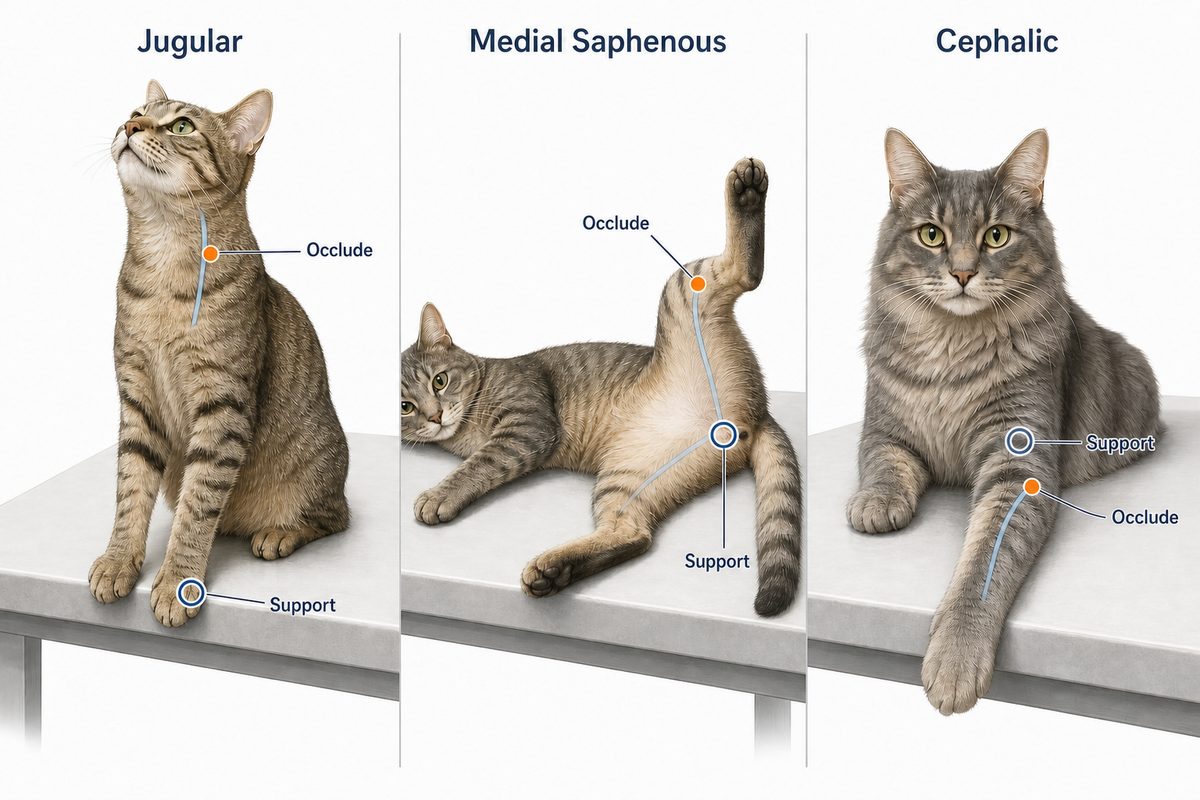
Original educational illustration. Orange marks the occlusion point, blue marks where the holder supports the limb. Hands are deliberately not drawn; what matters is where the pressure and the support go.
When a Towel Helps
A towel is not a way to hold tighter. It works because it spreads contact over the whole body instead of a few pressure points, and because it covers the claws.
Wrap the body. Leave the head out, and leave out the leg you are sampling.
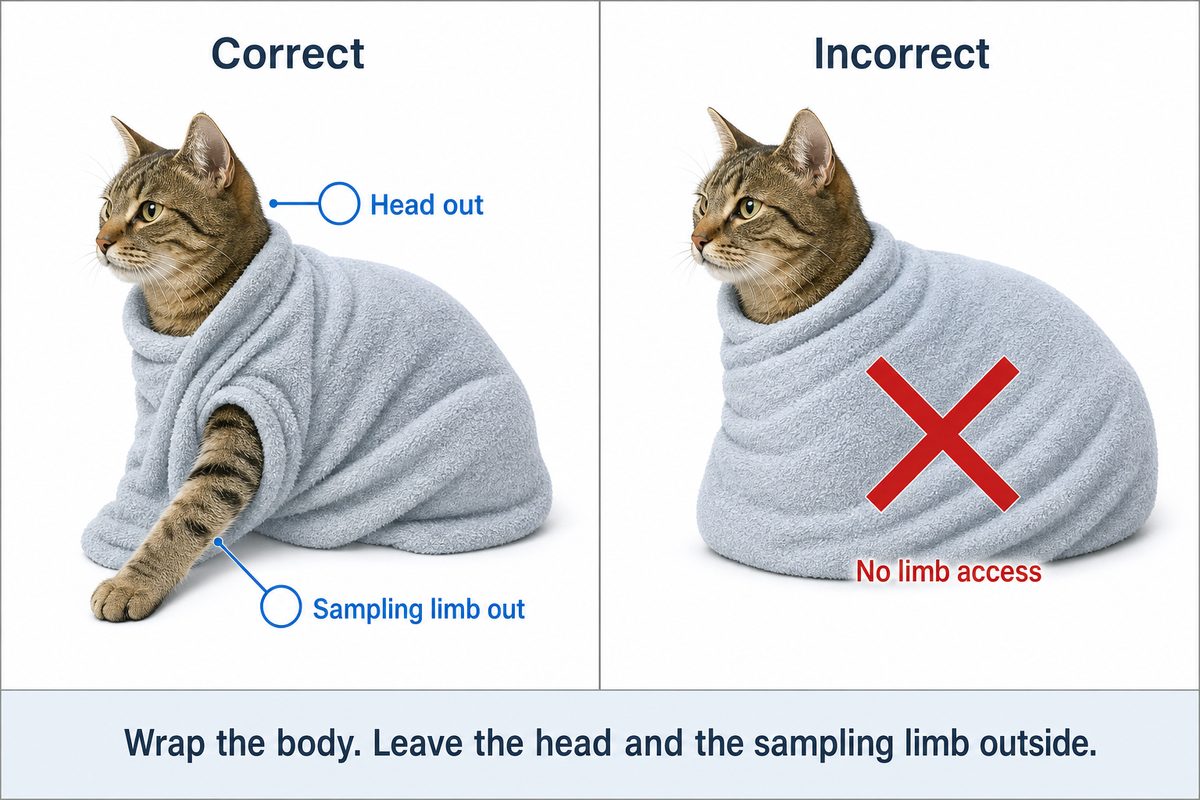
Original educational illustration comparing a usable wrap with one that traps the sampling limb.
Used at the right moment, a wrap settles a cat that was bracing against individual hands. Used badly, it is worse than nothing:
- Too late. A cat that has already escalated will fight the towel itself. Wrap during setup, not as a rescue.
- Not needed. If the cat is accepting a light hold, adding a towel just introduces a new restraint for no benefit.
- Wrong limb wrapped. If the wrap traps the leg you need, you have to unwrap halfway through. That is usually when the cat leaves.
Signals That Mean Stop
“Watch the cat” is too vague to act on. Here is what to watch for, in the order it happens.
Early — change something now: the cat goes still in a tense, frozen way; ears rotate back; tail tucks; pupils widen; weight shifts away from you. At this stage you can still fix it. Change the position, change the vein, slow down, or send one person out of the room.
Middle — the current plan has failed: the cat pulls the leg back, turns its head toward your hands, vocalizes low, tenses all over, or repositions to face you. Do not push on. Decide what to change.
Late — stop: growling, hissing, swatting, biting, urinating, or a sudden violent escape attempt. Do not work through this stage. Someone gets hurt, and the cat is worse at every future visit.
One habit makes this reliable: the person with the needle watches the vein, and the person holding the cat watches the cat. Whoever is watching the cat can stop the procedure without asking.
Two People, Two Jobs
One person holds and presents the vein. One person takes the sample. The holder’s job is the harder of the two.
The holder positions the cat, occludes the vein, and steadies the leg — usually holding the upper part of the leg while the sampler holds the lower part. The holder also decides when to stop.
A third person is usually a warning sign. If a cat needs three people, the position is normally wrong. More hands mean more contact, more noise, and more movement, which raises the cat’s stress instead of lowering it.
Agree out loud before the needle moves: who holds what, who occludes, when to release, and what word means stop.
When to Stop and Reschedule
Set an attempt limit before you start. Two attempts is a reasonable ceiling for one person. If a third attempt happens at all, someone more experienced should make it.
Stopping is not failure. A cat that leaves still handleable is worth more than one sample today.
Write down what happened, so the next visit starts better:
- which vein you tried
- which position the cat accepted, and which it refused
- what the escalation looked like, and how fast it came
- what to try first next time
Almost nobody does this, and it is the difference between a shorter visit next month and the same fight again.
If a cat cannot be sampled safely, the next step is a conversation with the attending veterinarian about options such as a pre-visit plan or sedation. That is a clinical decision for the veterinarian, not a handling decision for the person holding the cat.
Conclusion
Good restraint is a skill, not a matter of strength, and it is not down to the cat’s personality either.
The teams that get the sample on the first attempt do four things: they set up before touching the cat, they hold as lightly as the vein allows, they watch the patient instead of only the vessel, and they stop while stopping is still their decision.
Frequently Asked Questions
Is it ever acceptable to scruff a cat?
Current feline-friendly guidance does not support scruffing as routine practice and lists it, along with excessive restraint, as something to avoid. Do not make it your first move, and do not use it to compensate for poor positioning. If a cat cannot be handled safely without it, stop and discuss the case with the attending veterinarian.
How many attempts should you make before stopping?
Decide before you start, not during. Two attempts is a reasonable limit for one person, and any further attempt should be made by someone more experienced. What matters most is deciding in advance — a limit set mid-procedure is almost always set too late.
Does a cat need to be sedated for a blood draw?
Most do not. Sedation is one option when a cat cannot be sampled safely with good handling, and it is a clinical decision made by the attending veterinarian for that individual patient. It is not a shortcut for difficult handling, and it is not decided by the person holding the cat.
Sources
- American Association of Feline Practitioners / International Society of Feline Medicine — 2022 Cat Friendly Veterinary Interaction Guidelines: Approach and Handling Techniques (catvets.com)
- University of Minnesota — Veterinary Clinical Skills Compendium, Cat restraint for blood draws (open.lib.umn.edu)
- Cattledog Publishing — Low Stress Handling: preparing a cat for a blood draw visit (cattledogpublishing.com)
Disclaimer: This article is for professional education only and is not a substitute for veterinary advice, diagnosis, or treatment. Handling, restraint, and sedation decisions for an individual patient must follow your practice’s protocols and the direction of the attending veterinarian. Last updated: September 2026.
Training Resources
Restraint is learned on live cats under supervision. No model teaches it.
What a model does teach is the other half of the job. If the needle sequence is automatic, you are not thinking about it while the cat is losing patience, and your attention is free for the patient.
The Veterinary Cat IV Practice Kit is a feline peripheral-vein leg model for practicing vein puncture, blood draw with realistic flashback, catheter placement, and fluid-infusion setup. It represents a limb vein only. It is not a jugular model and does not simulate neck collection or restraint.
For handlers moving across from dogs, Cat vs Dog Venipuncture: What Actually Changes explains where patient tolerance stops being a side condition and becomes part of the clinical decision.