If your family has decided on circumcision, knowing what actually happens — and how to care for your baby afterward — takes a lot of the worry out of it. This guide walks through how a newborn circumcision is done, the pain relief used, the three common techniques, the healing timeline, and step-by-step aftercare, including what’s normal and when to call your clinician. For help deciding whether to circumcise in the first place, see our companion guide on the benefits, risks, and how to decide.
Important: This article is educational and describes a procedure performed by trained clinicians. It is not instructions for doing it yourself, and not a substitute for the guidance of your baby’s healthcare provider.
Before the Procedure
A newborn circumcision is usually done in the first few days to weeks of life, often before the baby goes home from the hospital. Beforehand, the clinician will:
- Confirm the baby is healthy and stable — circumcision is postponed for premature or unwell babies, and avoided entirely in certain anatomical conditions.
- Obtain informed consent from the parents.
- Feed and settle the baby, then position and gently secure him for the brief procedure.
The procedure itself typically takes only about 10–15 minutes.
Pain Relief and Anesthesia
Effective pain control is now the standard of care — newborns are not “too young to feel it,” so this matters. Clinicians typically use one or more of:
- A local anesthetic injection — a dorsal penile nerve block or a ring block — to numb the area. This is the most effective method.
- A topical numbing cream (such as a lidocaine-based cream) applied beforehand.
- A sucrose (sugar) solution on a pacifier and swaddling for additional comfort.
With proper anesthesia, babies tolerate the procedure well and usually settle quickly once it’s over. Plain acetaminophen may be suggested for comfort afterward if advised by your clinician.
The Three Common Techniques
Almost all newborn circumcisions use one of three devices. They achieve the same result in slightly different ways, and clinicians choose based on training and preference.
| Technique | How it works | Notable points |
|---|---|---|
| Gomco clamp | A bell is placed over the glans, the foreskin is drawn up and a metal clamp crushes then protects the rim while the foreskin is removed | Very common; little bleeding; no device left on the baby |
| Plastibell | A plastic ring is fitted over the glans and a suture tied around the foreskin; the foreskin is trimmed and the ring is left on to fall off on its own | Ring drops off by itself in about 5–10 days; no clamp removal needed |
| Mogen clamp | A flat clamp is applied across the foreskin and it is removed in a single motion | Fast procedure; commonly used in religious circumcisions |
All three are considered safe in trained hands. The key safety principles are the same regardless of device: protect the glans, remove the right amount of skin, and control bleeding.
What Happens During the Procedure
While the details depend on the device, the general sequence is:
- The baby is positioned and the area is cleaned with antiseptic.
- Pain relief is given (numbing injection and/or cream, plus sucrose for comfort).
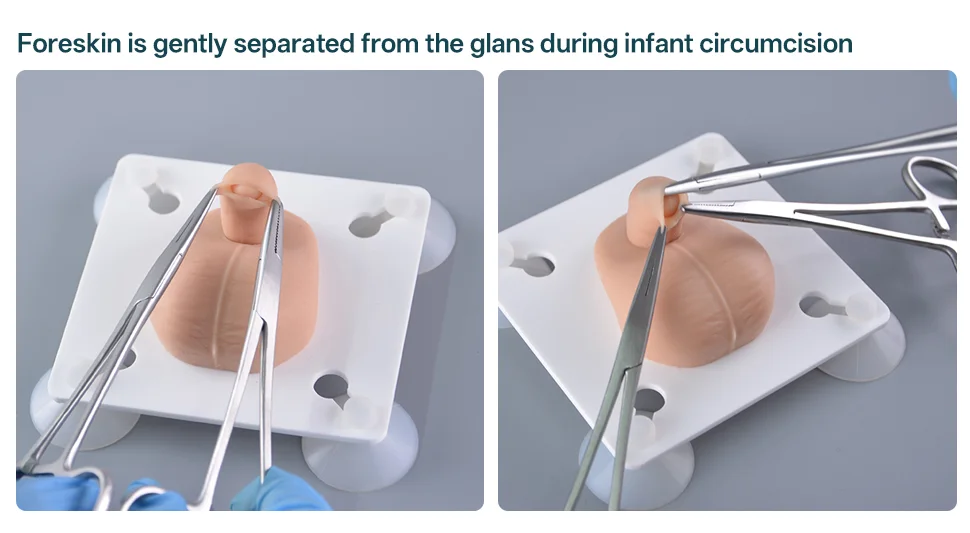
- The foreskin is gently separated from the glans and the chosen device is applied.
- The foreskin is removed and any bleeding is controlled.
- The area is dressed — often with petroleum jelly and gauze (with a Plastibell, the ring is simply left in place).
The baby is then swaddled and handed back to be comforted and fed.
Healing Timeline: What to Expect
Healing usually takes about 7 to 10 days. A rough picture:
- First 24 hours: the tip may look red and a little swollen; the baby may be fussier than usual.
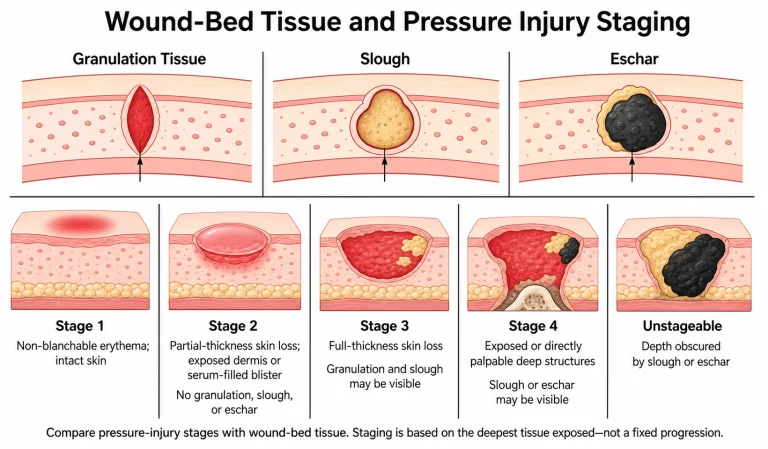
- Days 2–4: a soft yellowish film often forms over the healing glans. This is normal granulation tissue — not pus — and should be left alone.
- Days 5–10: swelling settles; with a Plastibell, the plastic ring falls off on its own (don’t pull it). The area looks pinker and more normal.
- By about two weeks: healing is generally complete.
Aftercare: How to Care for a Circumcised Infant
Day-to-day care is simple, and your clinician will give you specific instructions. In general:
- Keep it clean and gentle. Wash with warm water during normal diaper changes; avoid scrubbing and harsh wipes on the area.
- Use petroleum jelly (or as directed) on the tip or on the gauze at each diaper change for the first several days, so it doesn’t stick to the diaper — unless a Plastibell ring is in place, in which case follow your clinician’s specific advice.
- Diaper carefully. Fasten the diaper loosely enough to avoid pressure, and change it promptly to keep the area clean.
- Leave a Plastibell ring alone and let it fall off naturally within about 5–10 days.
- Comfort and feed as usual — holding and feeding help settle a fussy baby.
What’s Normal vs. When to Call the Doctor
Usually normal:
- Mild redness and swelling for a few days.
- A yellowish film over the tip (granulation tissue).
- A small amount of spotting on the diaper at first.
Call your clinician promptly if you see:
- Bleeding more than a few drops — for example, a spreading spot larger than a coin.
- Signs of infection: increasing redness or swelling, warmth, pus or foul-smelling discharge, or fever.
- No wet diaper / not urinating within 6–8 hours after the procedure.
- A Plastibell ring that hasn’t fallen off after about two weeks, or that has slipped onto the shaft.
When in doubt, call — it’s always better to have a quick question answered than to wait.
Possible Complications
Newborn circumcision is low-risk, but parents should be aware of the main complications so they can act early:
- Bleeding — the most common, usually minor and easily controlled.
- Infection — uncommon with good aftercare; watch for the warning signs above.
- Too much or too little skin removed, or adhesions (skin sticking to the glans) that occasionally need follow-up.
- Meatal stenosis — a narrowing of the urinary opening that can develop later and is treatable.
Choosing an experienced provider and following the aftercare plan keeps these risks low.
Training and Simulation
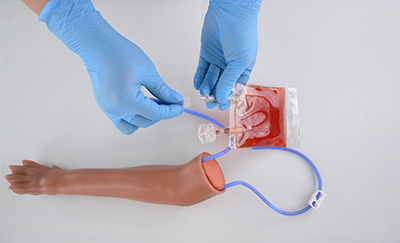
Because circumcision is a precise procedure with little margin for error, it is a skill that benefits enormously from practice on a model before performing it on a newborn. Rehearsing device placement, judging how much skin to remove, and controlling the steps on a realistic trainer builds the confidence and consistency that keep real procedures safe.
Frequently Asked Questions (FAQ)
Will my baby feel pain after the procedure?
Most of the discomfort is brief. With proper anesthesia the procedure itself is well tolerated, and afterward babies are usually only mildly unsettled for a day or so. Your clinician may suggest plain acetaminophen for comfort, and feeding, holding, and swaddling all help. Pain that seems to be increasing rather than easing after the first day, or that comes with redness, swelling, or fever, is worth a call.
Can my baby breastfeed and behave normally afterward?
Yes. Most babies feed and settle normally soon after, especially with good pain relief. Some are a little fussier for a day; feeding and comforting help.
Can I bathe my baby after a circumcision?
Gentle sponge baths are usually fine right away, but many clinicians suggest holding off on full tub baths for a few days until healing is underway (and the umbilical cord stump has healed). Avoid soaking the area at first, and pat — rather than rub — it dry. Follow your clinician’s specific advice.
Sources
- American Academy of Pediatrics (AAP) — Circumcision technical report (technique and pain management)
- StatPearls / NCBI Bookshelf — Neonatal Circumcision (Gomco, Plastibell, Mogen techniques)
- NHS — Circumcision in babies: procedure and aftercare
- American Academy of Family Physicians (AAFP) — Newborn circumcision technique and care
- Mayo Clinic — Circumcision: what to expect and recovery
This article is for general education only and describes a procedure carried out by qualified clinicians. It is not instructions for self-treatment and not a substitute for professional medical advice. Follow your own clinician’s aftercare guidance for your baby.
🩺 For Students, Clinicians, and Training Teams
Device placement and judging how much foreskin to remove are skills best rehearsed before the real thing. Our Infant Circumcision Training Model Kit includes replaceable foreskins so trainees can practice the Gomco, Plastibell, or Mogen techniques repeatedly on a realistic model.