Urinary catheterization helps drain or collect urine. It can relieve a full bladder, support certain procedures, or help a clinical team track urine output.
It also has risks. A catheter can cause infection, pain, blockage, and urethral injury. These risks rise when the device is used without a clear reason or left in longer than needed.
There is more than one type of urinary catheter. This guide explains the main options, when they may be used, and the basic care that helps prevent problems.
This article is for medical education. It does not teach untrained readers to insert or manage a catheter without professional guidance.
What Is Urinary Catheterization?
Urine travels from the kidneys to the bladder and leaves through the urethra. A catheter provides another way to drain or collect it.
Some catheters pass through the urethra into the bladder. Others stay outside the body. A suprapubic catheter enters the bladder through a small opening in the lower abdomen.
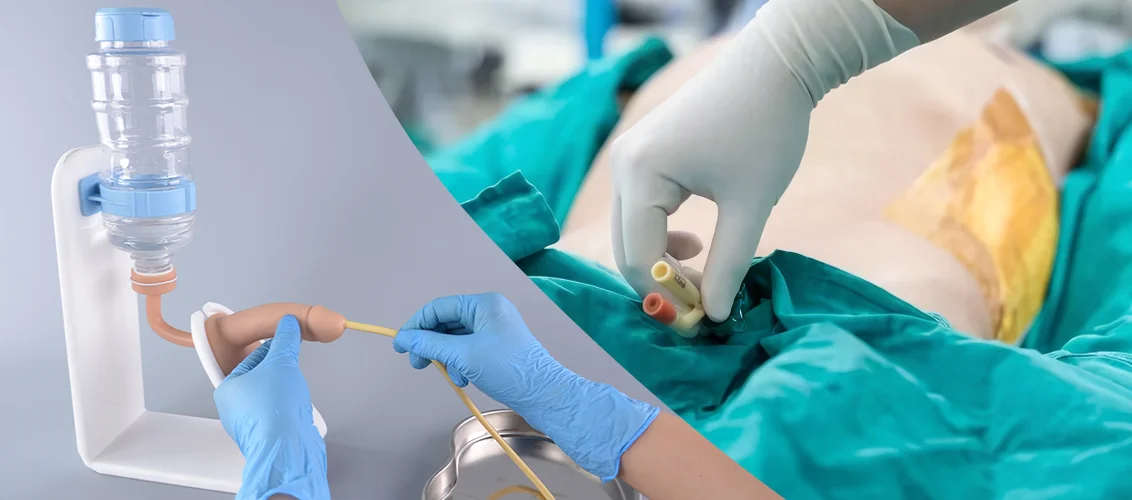
A Foley catheter is one type of urinary catheter. It stays in the bladder and is held in place by a small balloon. Not every urinary catheter is a Foley.
Before using a catheter, the clinical team should ask:
- What problem needs to be solved?
- Is a catheter necessary?
- Which type has the lowest reasonable risk?
- When can it be removed?
When Is a Urinary Catheter Needed?
A catheter should have a clear medical reason. It should not be used only for convenience.
Acute urinary retention
Urinary retention means the bladder cannot empty properly. A person may be unable to urinate, pass only a small amount, or have pain and swelling in the lower abdomen.
A catheter can drain the bladder while the cause is assessed. Possible causes include an enlarged prostate, urethral blockage, nerve problems, constipation, medication effects, or recent surgery.
Blood at the urethral opening after pelvic trauma may suggest a urethral injury. In that situation, routine catheter insertion should stop until an experienced clinician assesses the patient.
Ongoing problems with bladder emptying
Some nerve and bladder conditions cause long-term incomplete emptying. Intermittent catheterization may be used when suitable. The catheter drains the bladder and is then removed.
The schedule and technique depend on the patient. They should be set by a qualified clinician.
Selected operations
A catheter may be needed during a long operation, urinary tract surgery, or a procedure that requires close fluid monitoring.
Not every surgical patient needs one. When a catheter is used, the team should remove it as soon as the reason for it has ended.
Close urine-output monitoring
Hourly urine output can guide care in some critically ill patients. This does not mean every hospital patient needs a Foley catheter. Less invasive collection methods may be enough for a stable patient.
Selected wound or comfort needs
In some cases, a catheter may help keep urine away from a serious sacral or perineal wound. It may also support comfort-focused care near the end of life.
These are individual decisions. A Foley catheter is not the default solution for incontinence or limited mobility.
Types of Urinary Catheters
The right device depends on the goal. Does the bladder need to be emptied, or does urine only need to be collected?
| Type | How it works | Common use | Stays in place? |
|---|---|---|---|
| Intermittent catheter | Passes through the urethra to drain the bladder, then comes out | Scheduled bladder emptying for selected patients | No |
| Indwelling or Foley catheter | Passes into the bladder; a balloon holds it in place and tubing connects to a bag | Continuous drainage for a valid medical reason | Yes |
| External urinary device | Collects urine outside the urethra | Collection for some people who can pass urine but cannot toilet reliably | Yes, with regular skin and fit checks |
| Suprapubic catheter | Enters the bladder through a tract in the lower abdomen | Selected long-term needs or when the urethral route is unsuitable | Yes |
Catheter size, length, material, tip, balloon, and drainage system are not one-size-fits-all. The choice should follow the patient’s anatomy, the clinical goal, local policy, and the device instructions.
A larger catheter is not automatically better. It may cause more pain or urethral injury.
Urinary Retention vs Incontinence
Retention and incontinence can both cause wet clothing or bedding, but they are different problems.
Urinary retention means the bladder does not empty well. The person may feel full, strain, pass only small amounts, or leak because the bladder is overfilled. An external collection device will not drain a retained bladder.
Urinary incontinence means urine leaks without control. The bladder may still empty. Care may include toileting support, mobility help, absorbent products, pelvic-floor care, medication review, or an external device.
New inability to urinate, a painful full bladder, or overflow leakage needs clinical assessment.
Male vs Female Urinary Catheters
The safety basics are the same for every patient: confirm the need, explain the procedure, use aseptic technique, advance gently, and remove the catheter as soon as possible.
Anatomy changes the method.
The male urethra is longer and curves through the penis and prostate area. Prostate enlargement, narrowing, or previous procedures can make insertion difficult. A short catheter designed only for female anatomy must not be used for a male patient.
The female urethra is shorter. The main challenge is often finding and keeping a clear view of the urethral opening without contaminating the sterile field.
Our clinical guide, Foley Catheter Insertion: Male vs Female Steps, compares the landmarks, procedure, common errors, and stop points.
Main Risks and Complications
Catheter-associated urinary tract infection
An indwelling catheter gives bacteria a route into the urinary tract. The risk grows with each day the device remains in place.
The best prevention is simple: use a catheter only when needed, keep the drainage system closed, and remove it early.
Cloudy or strong-smelling urine alone does not prove infection. Fever, flank pain, pelvic discomfort, and other symptoms must be considered. Testing and treatment should follow clinical guidance.
Urethral or bladder injury
Forceful insertion can cause bleeding, a false passage, or urethral damage. Inflating the balloon before it is fully inside the bladder can cause serious injury.
Severe pain, resistance, new bleeding, or repeated failed attempts are reasons to stop and escalate.
Blockage, leakage, and bladder spasms
Poor drainage may result from a kink, a compressed tube, debris, encrustation, constipation, bladder spasm, or incorrect position.
Urine leaking around the catheter does not always mean a larger catheter is needed. The cause should be checked first.
Skin injury and reduced mobility
Tubing can pull on the urethra or press against the skin. A poorly fitted external device can also damage skin.
The catheter and tubing should be secured without tension. The bag and tubing should still allow safe movement.
Basic Catheter Care
Care differs by device and patient, but these points apply to most indwelling urinary catheters:
- Clean your hands before and after touching the catheter, tubing, or bag.
- Keep the catheter connected to a closed drainage system.
- Keep the bag below bladder level and off the floor.
- Keep tubing free of kinks, pressure, and low loops that trap urine.
- Secure the catheter so it does not pull on the urethra.
- Use gentle routine hygiene. Do not scrub with harsh antiseptics.
- Empty the bag with a clean technique before it becomes too full.
- Do not disconnect, flush, clamp, replace, or add balloon fluid unless the care team directs it.
- Check the reason for the catheter every day and remove it when it is no longer needed.
Patients and caregivers need instructions for their exact device. Intermittent, external, Foley, and suprapubic catheters do not share one universal home-care routine.
Warning Signs That Need Medical Attention
Contact a healthcare professional promptly if there is:
- little or no urine draining when urine is expected, especially with lower-abdominal pain;
- a catheter that has fallen out, been pulled, or looks displaced;
- severe pain, visible blood, clots, or new bleeding;
- fever, chills, flank pain, pelvic pain, confusion, or rapidly worsening illness;
- repeated blockage, bladder spasms, or leakage around the catheter;
- redness, swelling, discharge, an open sore, or pressure injury around the device.
Do not push a displaced catheter back in. Severe pain, heavy bleeding, or a rapidly worsening condition may need emergency care.
Conclusion
Urinary catheterization is not one device or one treatment plan. Intermittent catheters empty the bladder and come out. Foley catheters stay in place. External devices collect urine without entering the urethra. Suprapubic catheters drain the bladder through the lower abdomen.
Safe care starts with a clear reason. Choose the least invasive suitable option, use trained technique, keep urine flowing freely, and remove the catheter as soon as it is no longer needed.
Frequently Asked Questions
Is urinary catheterization painful?
It may cause pressure, stinging, or brief discomfort. Severe or increasing pain is a reason to stop and reassess. It can signal resistance, injury, poor lubrication, or incorrect position.
Can a urinary catheter be used only at night?
Some patients have a planned nighttime or intermittent schedule. It is not suitable for everyone. A clinician should set the timing based on the bladder problem, device, infection risk, mobility, skin condition, and ability to manage it safely.
Does every patient need a catheter after surgery?
No. The need depends on the operation, anesthesia, duration, fluid plan, mobility, and risk of retention. If a catheter is used, the team should also set a removal plan.
Sources and Medical Disclaimer
- CDC: Summary of Recommendations for CAUTI Prevention
- CDC: Preventing Catheter-Associated Urinary Tract Infections
- American Family Physician: Urinary Catheter Management
- European Association of Urology Nurses: Indwelling Catheterisation in Adults
This article is for medical education and simulation training. It does not replace diagnosis, treatment, device instructions, local policy, or supervised clinical training. Patients and caregivers should follow the plan provided by their healthcare professional.
Training Resources
The Urinary Catheterization Trainers collection supports supervised practice in male catheterization, sterile-field setup, anatomical orientation, insertion control, and drainage-system setup.
For hands-on practice, the Male Urethral Catheterization Simulator has an S-curved urethra, a 473 mL bladder reservoir that returns simulated urine, and an included Foley catheter. The Wearable Urinary Catheterization Model adds palpable landmarks, simulated urine extraction, and bladder-puncture practice with replaceable skin and bladder.