Foley catheter insertion drains the bladder through a tube that stays in place. A small balloon holds the catheter inside the bladder.
The goal is the same for male and female patients, but the anatomy and common problems are different. Male insertion follows a longer urethra. Female insertion depends on seeing the urethral opening clearly and keeping the sterile field clean.
This guide is for trained healthcare staff and students in supervised skills practice. It does not replace local policy, a device’s instructions, or hands-on competency training.
For catheter types, indications, risks, and daily care, read Urinary Catheterization: Types, Indications, and Care.
When to Stop Before Starting
First confirm that an indwelling catheter is needed. A less invasive option may be safer.
Explain the procedure, confirm the patient’s identity and allergies, protect privacy, and obtain consent according to local policy.
Stop and get experienced help when there is:
- pelvic trauma or possible urethral injury;
- blood at the urethral opening;
- recent urethral, prostate, bladder, or other urologic surgery without a clear plan;
- a known stricture, false passage, reconstruction, or history of difficult insertion;
- severe pain, bleeding, firm resistance, or repeated failed attempts;
- uncertainty about the anatomy or catheter position.
Never force a catheter through resistance. Extra pressure can cause urethral trauma or create a false passage.
Equipment and Sterile Setup
Use an approved catheterization kit or the items required by local policy. Typical equipment includes:
- a sterile Foley catheter of the correct type and size;
- a closed drainage system and collection bag;
- sterile gloves and drapes;
- approved cleaning supplies;
- sterile water-soluble lubricant;
- a syringe and the fluid named in the catheter instructions;
- securement equipment;
- protective equipment and waste supplies;
- a specimen container if a urine sample is ordered.
Check the package, expiry date, catheter details, and balloon instructions before opening the sterile field.
Do not preinflate the balloon unless the device instructions or local policy require it. Routine practice differs between products and facilities.
Male vs Female Anatomy
| Point | Male insertion | Female insertion |
|---|---|---|
| Urethra | Longer and curved | Shorter |
| Main landmark | Urethral opening at the glans | Urethral opening in front of the vaginal opening |
| Main challenge | Passing gently through a longer route and prostate area | Keeping the urethral opening visible without contamination |
| Important risk | Urine may appear before the balloon is fully inside the bladder | A catheter that enters the vagina cannot be redirected into the urethra |
Position the patient for safety, access, and comfort. Pain, pregnancy, limited mobility, contractures, or recent surgery may require a different position or extra help.
Shared Foley Catheter Insertion Steps
The basic sequence is similar for male and female patients:
- Confirm the plan. Check the indication, patient, allergies, catheter type, and relevant urologic history.
- Explain and position. Tell the patient what they may feel and agree on a signal to pause.
- Prepare the equipment. Perform hand hygiene and place the bag where it can remain below the bladder.
- Create the sterile field. Open the kit and put on sterile gloves without contaminating the supplies.
- Prepare the catheter. Connect the closed system if needed and lubricate the catheter.
- Clean the urethral area. Use the approved solution and sex-specific cleaning sequence.
- Insert gently. Watch the patient’s response. Stop if pain or resistance does not settle with safe reassessment.
- Confirm bladder entry. Urine return matters, but it may not prove that the balloon is fully inside the bladder.
- Inflate, seat, and secure. Use only the fluid and volume stated in the device instructions. Keep the bag below the bladder and remove tubing kinks.
- Document. Record the reason, device details, balloon volume, urine findings when needed, patient response, and review or removal plan.
Male Foley Catheter Insertion: Step by Step
- Position and drape the patient. Place the patient on their back with the legs comfortably extended or slightly apart.
- Inspect the area. Check for swelling, lesions, discharge, bleeding, or a foreskin that cannot move safely.
- Hold the penis with the nondominant hand. If the patient is uncircumcised, retract the foreskin only as far as it moves without force. This hand is now nonsterile.
- Clean the urethral opening. Use the sterile dominant hand and a fresh swab for each pass.
- Apply lubricant. Use the product and amount required by local policy. Allow time for anesthetic gel when prescribed.
- Align the urethra. Hold the penis in the position taught by your facility. Do not pull hard.
- Advance slowly. Ask the patient to breathe and relax if mild sphincter resistance occurs. Stop for severe pain, bleeding, or firm resistance.
- Advance far enough for balloon safety. Urine may flow when the catheter eyelets reach the bladder while the balloon is still in the urethra. Follow the device and local insertion guidance.
- Inflate the balloon only after secure placement. Stop if inflation causes pain or unusual resistance.
- Seat and secure the catheter. Gently pull back until the balloon rests at the bladder neck. Keep the drainage system closed and free of tension.
- Replace the foreskin. Return it to its normal position to prevent paraphimosis.
Female Foley Catheter Insertion: Step by Step
- Position and drape the patient. Use a safe position that gives a clear view of the perineum.
- Identify the landmarks. Find the clitoris, urethral opening, and vaginal opening before starting sterile cleaning.
- Separate the labia with the nondominant hand. Keep them separated during cleaning and insertion. This hand is now nonsterile.
- Clean from front to back. Use a fresh swab for each pass and follow the sequence in local policy.
- Lubricate the catheter. Keep the catheter sterile.
- Insert through the urethral opening. Advance gently until urine appears, then continue far enough to place the balloon section fully inside the bladder.
- If the catheter enters the vagina, do not redirect it. Leave it as a landmark if policy allows, then use a new sterile catheter and renewed sterile technique.
- Inflate the balloon only after secure placement. Stop if there is pain or resistance.
- Seat, secure, and drain. Keep the tubing free of kinks and the bag below bladder level.
The Main Male vs Female Differences
Male insertion requires careful advancement through a longer urethra. The most important balloon-safety point is that early urine flow does not always mean the catheter is far enough inside.
Female insertion requires a steady view of the urethral opening. The nondominant hand keeps the labia separated, while the sterile dominant hand cleans and inserts the catheter.
For both patients, the key habits are the same: do not force, do not inflate the balloon when position is uncertain, and do not keep repeating unsuccessful attempts.
Common Problems and What to Do
Resistance during male insertion
Check the position, lubrication, catheter route, and whether the patient can relax. Do not push harder or twist forcefully.
Resistance may come from sphincter tone, urethral narrowing, prostate anatomy, or a false passage. If it continues, stop and follow the escalation plan.
No urine return
Check for a kink, closed clamp, blocked eyelet, or poor bag position. The bladder may contain little urine, or the catheter may be in the wrong place.
Do not inflate the balloon until bladder placement is clear.
Pain during balloon inflation
Stop inflating. Pain or unusual resistance can mean that the balloon is still in the urethra.
If fluid has entered the balloon, deflate it fully. Reassess the position and get help when placement remains uncertain.
The catheter enters the vagina
That catheter is contaminated for urethral insertion. Do not pull it back and redirect it into the urethra.
If local policy allows, leave it as a visual landmark. Then use a new sterile catheter, new contaminated supplies as needed, and renewed sterile technique.
The sterile field is broken
Pause and replace the contaminated catheter, gloves, or field items. Continuing with contaminated equipment increases infection risk.
Urine leaks around the catheter
Do not automatically choose a larger catheter or add more balloon fluid. First check for kinks, blockage, bladder spasm, constipation, poor position, and whether the catheter is still needed.
Simulation Competency Checklist
A learner should be able to:
- confirm the indication and identify reasons to stop;
- explain the procedure and protect privacy;
- prepare equipment without contaminating the field;
- identify male and female landmarks;
- keep the nondominant hand in its nonsterile role;
- clean in the correct direction with a new swab for each pass;
- lubricate and advance gently;
- explain why urine return may not be enough before male balloon inflation;
- respond safely to resistance, pain, bleeding, vaginal placement, or no urine;
- inflate the balloon only after secure bladder placement;
- replace the foreskin when needed;
- secure the catheter and keep drainage closed and unobstructed;
- document the procedure and state when the device should be reviewed or removed.
Good performance is more than completing the steps. The learner must also know when to pause and ask for help.
Conclusion
Male and female Foley insertion follow the same safety framework but require different anatomical control.
Male insertion follows a longer route and requires enough advancement before balloon inflation. Female insertion depends on a clear view of the urethral opening and careful control of the sterile field.
In both procedures, the safest habits are gentle technique, clear placement before balloon inflation, and early escalation when something does not feel right.
Frequently Asked Questions
Why can urine appear before a male Foley catheter is fully inside the bladder?
The drainage holes near the tip can enter the bladder before the balloon section does. This is why the operator follows the catheter design and local advancement guidance before inflating the balloon.
Can a short female catheter be used for a male patient?
No. It may be too short to place the balloon safely inside the bladder. Choose a catheter designed for the patient’s anatomy and follow the product label and local policy.
When should difficult catheterization be referred?
Get experienced or specialist help for suspected urethral injury, complex anatomy, recent urologic surgery, firm resistance, bleeding, severe pain, repeated failure, or any doubt about the catheter route.
Sources and Medical Disclaimer
- CDC: Summary of Recommendations for CAUTI Prevention
- European Association of Urology Nurses: Principles of Management and Catheter Insertion
- MSD Manual Professional: How To Do Urethral Catheterization in a Male
- MSD Manual Professional: How To Do Urethral Catheterization in a Female
- American Family Physician: Urinary Catheter Management
This article is for healthcare education and supervised simulation. It does not replace device instructions, local policy, competency assessment, or patient-specific medical judgment. Untrained readers should not attempt Foley catheter insertion from an online guide.
Training Resources
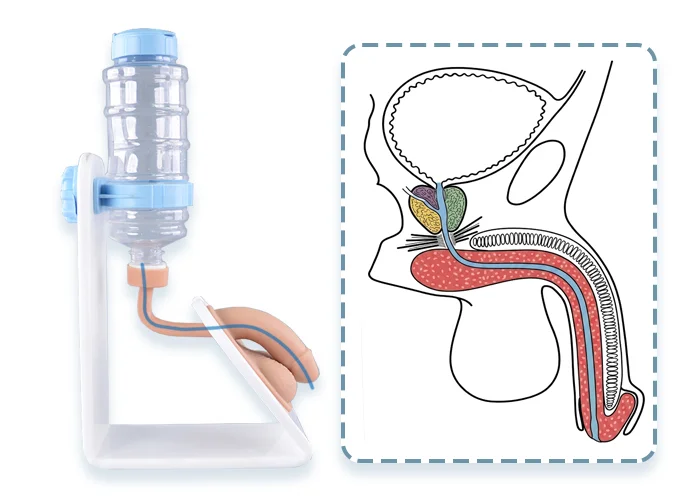
The Male Urethral Catheterization Simulator supports practice in anatomical orientation, insertion control, simulated resistance, and urine-return confirmation. The Wearable Urinary Catheterization and Bladder Puncture Model adds a separate bladder-puncture training module. Both are male-focused trainers. More options are listed under Urinary Catheterization Trainers.