Choosing among wound dressing types is easier when the question starts with the wound: Is it dry or draining? Superficial or deep? Is the surrounding skin intact or fragile? Does the wound need protection, moisture, absorption, or a low-trauma contact layer?
This practical guide matches common wound findings to dressing categories. It is designed for the decision made after a wound assessment. It does not replace diagnosis, pressure-injury staging, vascular assessment, debridement decisions, infection treatment, or a product’s instructions for use.
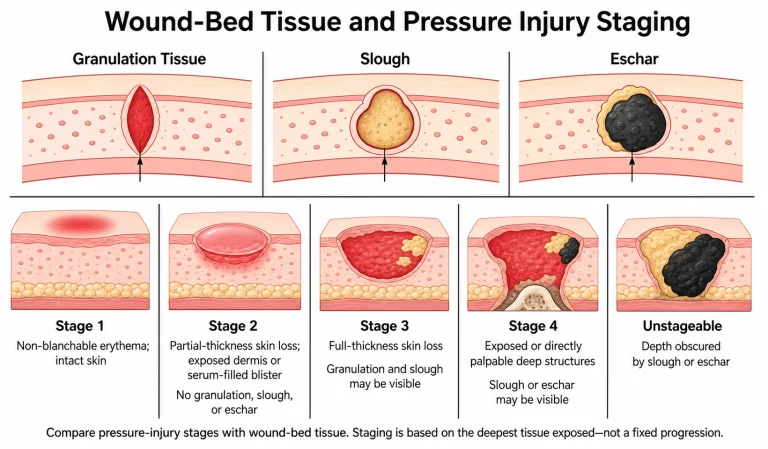
For wound-bed identification, see Granulation Tissue in Wound Healing. For staging, see Nursing Care Guidelines for Pressure Ulcer Stages.
Important: Dressing selection must follow a qualified clinician’s assessment, the patient’s plan, local policy, and the current instructions for the specific product. A dressing cannot correct untreated ischemia, pressure, infection, edema, repeated trauma, or another underlying cause.
Quick Wound Dressing Assessment and Selection Guide
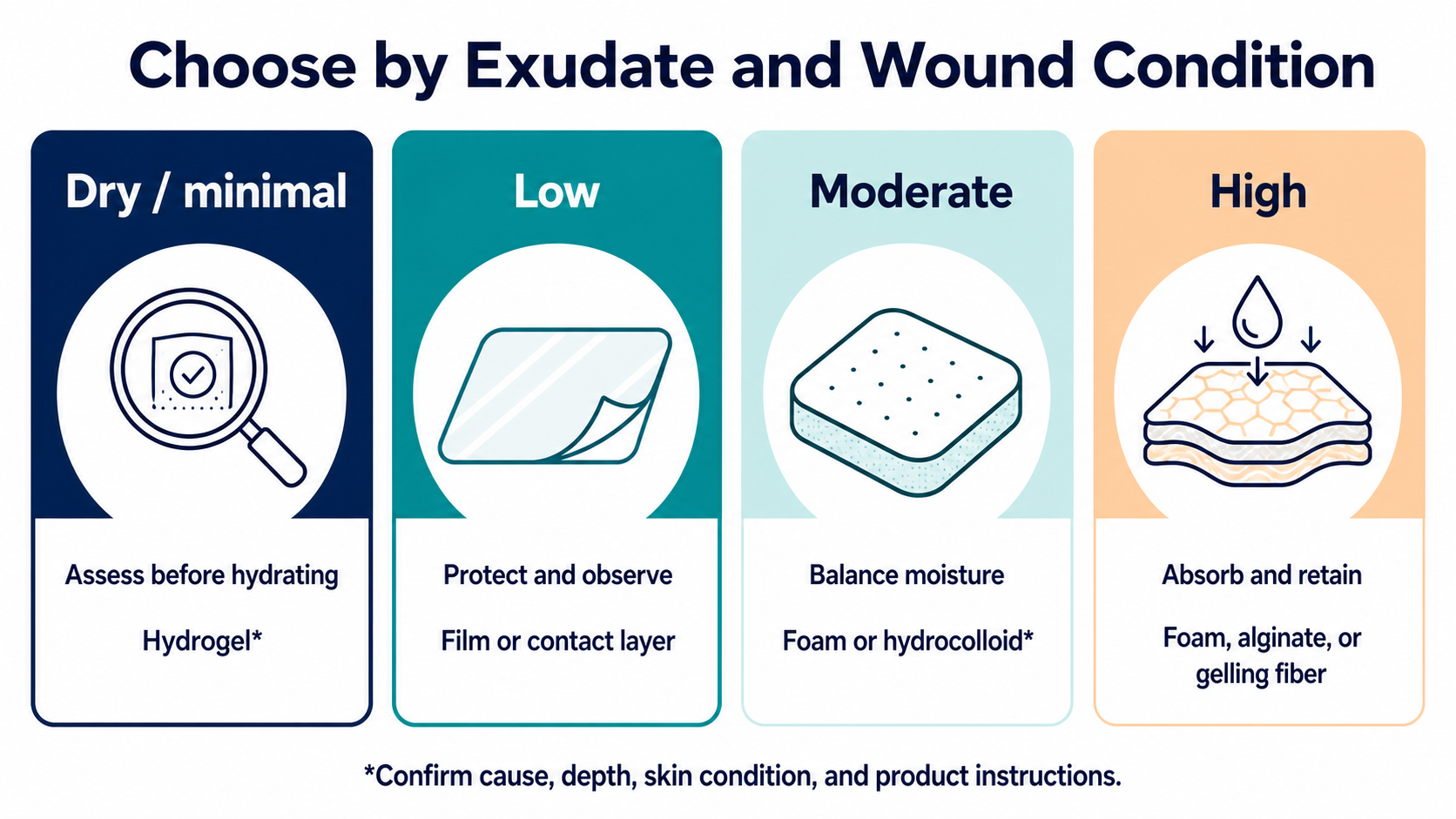
Before using the table, confirm the cause and perfusion; wound-bed tissue; exudate amount and dressing performance; depth and shape; periwound skin and removal pain; and any change from baseline. A dry ischemic wound is not simply a wound that needs hydrogel, and color alone should not be used to diagnose infection. If perfusion, depth, exposed structures, or deterioration is unclear, escalate the assessment before changing products.
The table links those findings to dressing categories. It is a category guide, not a prescription. Products within the same category vary in absorbency, adhesive, wear time, antimicrobial agent, and contraindications.
| Wound situation | Confirm during assessment | Dressing categories often considered | Avoid or watch for |
|---|---|---|---|
| Superficial wound with little or no exudate | Intact surrounding skin; no pooling fluid | Transparent film; non-adherent contact layer with a light cover | Film absorbs very little; avoid trapping increasing fluid or repeatedly stripping fragile skin |
| Dry or minimally exuding wound when hydration is appropriate | Cause of dryness and perfusion assessed | Hydrogel; selected hydrocolloid; low-adherent contact layer | Do not automatically hydrate ischemic wounds or stable dry eschar; prevent periwound maceration |
| Shallow wound with low-to-moderate exudate | Depth, skin tolerance, need for inspection | Thin foam; selected hydrocolloid; absorbent pad; contact layer plus cover | Occlusion and adhesive may not suit fragile skin, frequent inspection, or every infected wound |
| Moderate-to-high exudate | Amount, viscosity, leakage, change interval | Foam; alginate; gelling fiber/hydrofiber; superabsorbent secondary dressing | Do not use a highly absorbent product on a dry wound; saturation and leakage require reassessment |
| Fragile, painful, or easily traumatized surface | Removal pain, adhesive injury, skin tears | Soft-silicone or other non-adherent contact layer plus suitable secondary dressing | Contact layers usually do not provide enough absorption alone |
| Assessed cavity, undermining, or tunnel with drainage | Depth and route documented by a trained clinician | Appropriate ribbon/rope alginate or gelling fiber plus secondary cover | Do not blindly probe or tightly overpack; keep material retrievable and account for it at removal |
| Suspected local infection or high bioburden | Clinical signs, cause, systemic symptoms, local protocol | Clinician-selected antimicrobial dressing whose base also matches exudate and depth | Not routine prophylaxis; does not replace systemic treatment for spreading or systemic infection |
Common Types of Wound Dressings: Use and Cautions
Gauze and Non-Adherent Contact Layers
Consider when: the wound needs a cover, a low-trauma interface, or a primary layer that passes fluid to a secondary absorbent dressing. Gauze may also be used for cleansing or in a clinician-directed packing plan.
Watch for: plain dry gauze can adhere as it dries and injure tissue during removal. A contact layer and gauze are not interchangeable. Identify which layer protects the wound, which absorbs fluid, and how both will be removed.
Transparent Film
Consider when: a superficial or epithelializing wound has little or no exudate and needs protection with continued visibility. Film can also secure a compatible primary dressing.
Watch for: film has minimal absorption. Pooling, leakage, or maceration means the plan needs review. Adhesive film may damage fragile skin and requires intact periwound skin for fixation.
Foam
Consider when: the wound has moderate, or for some products higher, exudate and needs absorption, protection, or cushioning. Borderless formats may be useful when adhesive is unsuitable.
Watch for: foam capacity varies by thickness and construction. It may be too drying for a non-draining wound. Leakage, strike-through, lifting, or early saturation signals a mismatch in capacity, fit, or change interval. Foam does not replace pressure offloading.
Hydrocolloid
Consider when: a selected superficial or shallow wound has low-to-moderate exudate and would benefit from a moist, protective gel-forming dressing.
Watch for: occlusion, adhesive, and longer wear may not suit fragile skin, heavy exudate, frequent inspection, or some clinically infected wounds. Hydrocolloid gel may look yellow or brown at removal; assess the cleansed wound rather than calling the gel pus.
Hydrogel
Consider when: a dry or minimally exuding wound needs moisture donation under a clinical plan. Amorphous gels often require a secondary cover.
Watch for: hydrogel cannot manage heavy exudate and may macerate surrounding skin. Confirm perfusion and the cause of dryness before adding moisture.
Alginate and Gelling Fiber
Consider when: a wound has moderate-to-high exudate or an assessed draining cavity needs a conformable absorbent material. A secondary dressing is commonly required.
Watch for: these materials may adhere or dehydrate the wound when fluid is insufficient. In a cavity, document the product and amount inserted, keep it retrievable, confirm complete removal, and avoid narrow unassessed tracts or tight overpacking.
Antimicrobial Dressings
Consider when: a clinician identifies a local indication and selects silver, iodine, PHMB, medical-grade honey, or another agent under a defined plan. The underlying foam, alginate, contact layer, or other format must still match exudate and depth.
Watch for: antimicrobial dressings are not a default for every open wound. Check allergies, contraindications, compatibility, duration, and the review date. They do not replace source control or systemic treatment when infection is spreading or systemic.
Four Practical Decisions That Prevent Common Errors
1. Match Absorption to Actual Exudate
The aim is balanced moisture, not maximum absorption. A dry wound may adhere to alginate or an overly absorbent foam. A heavily draining wound may overwhelm film or a thin dressing.
The phrase dry dressing for wounds may mean dry sterile gauze used as a cover. It does not mean dry gauze is the correct treatment for every dry wound bed.
2. Do Not Diagnose Infection From Drainage Alone
Record amount, color, consistency, odor after cleansing, and change from baseline. Blood, irrigation fluid, medications, dressing gel, and debris can alter appearance. A sudden increase or purulent-appearing drainage supports reassessment, but no single wound discharge type diagnoses infection.
3. Give Every Layer One Job
The primary layer contacts the wound and addresses the wound-bed goal. The secondary layer absorbs additional fluid, secures the primary product, or protects from the environment. Fixation must tolerate movement without stripping skin or constricting circulation.
More layers are not automatically safer. Unnecessary combinations can trap fluid, add pressure, reduce the action of another product, or make removal difficult.
4. Protect the Periwound Skin
Choose adequate fluid capacity and a realistic change interval. Match adhesive to skin tolerance, consider a skin barrier when indicated, avoid tension during application, and support the skin during slow removal. New blistering, sharply outlined redness, itch, or skin loss may indicate adhesive injury or dermatitis rather than infection.
When to Reassess or Escalate
Reassess the dressing plan when it leaks, saturates early, lifts, adheres, causes bleeding or increasing pain, or leaves the wound and surrounding skin too wet or too dry. Also reassess when drainage changes unexpectedly or healing stalls despite consistent care and treatment of the cause.
Seek urgent clinical assessment for systemic illness, confusion, rapidly spreading redness, discoloration or swelling, severe or disproportionate pain, uncontrolled bleeding, exposed deep structures, suspected ischemia, or rapid deterioration. A different dressing alone is not an adequate response.
A Simple Teaching Checklist
When comparing different types of wound care dressings, ask the learner to state:
- The wound findings that matter.
- One immediate management goal: protect, hydrate, absorb, minimize trauma, or manage an assessed cavity.
- The dressing property required to meet that goal.
- One suitable category and one reason it may not be suitable.
- The finding that would trigger reassessment or escalation.
This sequence tests clinical reasoning instead of brand recall or memorization of wound dressing items.
Conclusion
Wound dressing types should be chosen by wound condition and required function. Film protects and permits inspection but absorbs little. Hydrogel donates moisture. Foam absorbs and cushions. Hydrocolloid forms a protective gel in selected wounds. Alginate and gelling fiber handle exudate and may conform to assessed cavities. Contact layers reduce removal trauma but often need a secondary dressing. Antimicrobial versions require a clinical indication and review plan.
Assess cause, perfusion, exudate, depth, surrounding skin, pain, and change from baseline. Then select the simplest compatible dressing system, inspect the used dressing, and change the plan when the wound changes.
Frequently Asked Questions
Which dressing is best for a wound with heavy drainage?
Foam, alginate, gelling fiber, or a superabsorbent secondary dressing may be considered depending on depth, shape, skin condition, and the specific product’s capacity. Persistent heavy drainage also requires review of its cause; adding more absorbent layers is not a complete assessment.
Can alginate or gelling fiber be placed in a wound cavity?
Only under a documented clinician-directed plan after the cavity or tunnel has been assessed. Use a retrievable format, record what was inserted, account for all material at removal, and never tightly overpack or push fragments into an unassessed tract.
Can different dressing layers be combined?
Yes, when each compatible layer has a defined role. For example, a low-adherent contact layer may protect tissue while a secondary pad manages fluid. Avoid combining products without checking instructions, because the combination may trap moisture, add pressure, impair another product’s action, or complicate removal.
Sources and Medical Disclaimer
- Wounds UK: Wound Management and Dressing Selection
- WoundSource: Types of Wound Dressings—Features, Indications and Contraindications
- WoundSource: Wound Dressing Selection—Types and Usage
- NCBI Bookshelf: Wound Dressings
- Advances in Wound Care: Choosing a Wound Dressing Based on Common Wound Characteristics
- International Wound Journal: Wound Exudate and the Role of Dressings
- NICE: Chronic Wounds—Advanced and Antimicrobial Dressings
- International Wound Infection Institute: Wound Infection in Clinical Practice—Consensus Update 2022
This content is for education and clinical training. It does not diagnose a wound, prescribe a dressing, or replace assessment and an individualized plan from a qualified healthcare professional. Category-level descriptions cannot capture every product. Indications, contraindications, application, compatibility, and wear time vary; follow local policy and the current manufacturer instructions.
Training Resources
MEDTACEDU’s Pressure Ulcer Model 4 Stages Kit can support structured observation and documentation before learners discuss dressing options under educator supervision.
For trauma simulation, the Wound Packing Trainers collection provides varied cavity shapes for practicing assessment, packing, pressure, and reassessment. These models teach procedural and decision skills; they do not recommend wound-packing material as a routine dressing or replace supervised clinical wound-care education.