In the first day or two of life, almost every baby has a few drops of blood taken from the heel — the newborn heel stick (also called a heel prick or heel lance). It looks small but does a big job: it screens for serious but treatable conditions before any symptoms appear. This guide explains what a heel stick is, why it’s done, what’s tested, whether it hurts, and what to expect as a parent. For the clinical side — exactly where and how the puncture is done — see our companion guide on how to perform a heel stick on an infant.
Important: This article is for general education and is not medical advice. Follow the guidance of your baby’s healthcare team.
What Is a Heel Stick?
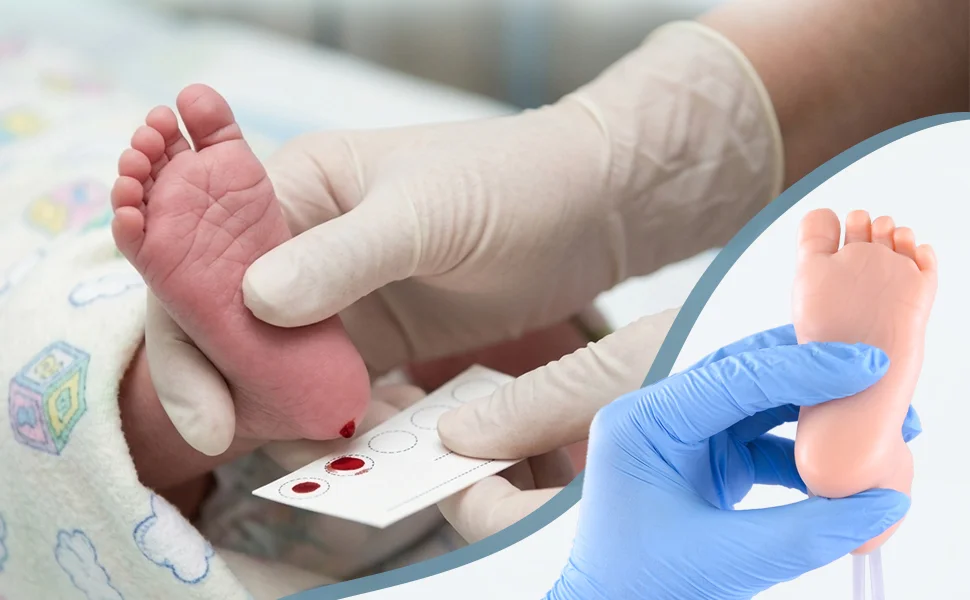
A heel stick is a quick way to collect a small blood sample from a newborn’s heel. A clinician warms the heel, makes a tiny puncture on the side of it with a special lancet, and collects a few drops of blood — usually onto a special filter-paper card (the “blood spot” card) or into a small tube.
The heel is used because a newborn’s heel has a good blood supply and is easy to access safely, and because babies this small don’t yet have easy veins to draw from the way older children and adults do.
Why Is a Heel Stick Done?
The heel stick has a few important uses in the newborn period:
- Newborn screening (the main reason). Every drop on that blood-spot card is tested for a panel of serious but treatable conditions — metabolic, genetic, hormonal, and blood disorders — that usually show no symptoms at birth. Catching them early, before damage is done, is the whole point.
- Checking bilirubin if the baby has jaundice (yellowing of the skin), to decide whether treatment is needed.
- Checking blood sugar (glucose) in babies at risk of low blood sugar, such as some infants of mothers with diabetes.
- Other small blood tests when needed, since the heel is a convenient site in a tiny baby.
What Does Newborn Screening Test For?
The exact panel varies by country and region, but newborn blood-spot screening commonly looks for conditions such as:
- Metabolic disorders like phenylketonuria (PKU), where the body can’t process part of food normally.
- Congenital hypothyroidism, a treatable thyroid hormone deficiency.
- Sickle cell disease and other inherited blood disorders.
- Cystic fibrosis.
- A range of other rare inherited conditions, depending on the local program.
The common thread is that all of these are far better managed when caught early — often with diet, medication, or close monitoring — which is why screening is offered to every baby.
When Is It Done?
Newborn screening is usually done when the baby is about 24 to 48 hours old, often just before leaving the hospital or at an early home or clinic visit. Timing matters because some conditions only show up reliably after the baby has been feeding for a day or so. Occasionally a repeat sample is requested — usually because the baby was tested very early, was premature, or the first sample needed to be redone, not because something is wrong.
Does a Heel Stick Hurt the Baby?
It causes brief discomfort — a quick pinch — but it’s over fast, and there are well-proven ways to keep babies comfortable:
- Breastfeeding or skin-to-skin contact during the test.
- A small amount of sucrose (sugar) solution on a pacifier.
- Swaddling and gentle holding.
- Warming the heel beforehand, which also helps the blood flow so fewer punctures are needed.
Most babies settle within moments, especially when held and fed.
What to Expect: Before, During, and After
- Before: the clinician may warm your baby’s heel for a few minutes to improve blood flow.
- During: the heel is cleaned, a tiny puncture is made on the side of the heel, and a few drops are collected. It takes only a minute or two.
- After: gentle pressure and a small bandage; you can comfort and feed your baby right away. A little bruising is normal.
Blood-spot cards are sent to a lab, and results usually take a few days to a couple of weeks. No news is generally good news; if a result needs a closer look, your team will contact you for a simple follow-up test. An initial “positive” screen is not a diagnosis — it just means more testing is needed to be sure.
Frequently Asked Questions (FAQ)
Is the newborn heel stick required?
Newborn screening is strongly recommended everywhere and is offered to every baby, though the exact rules vary by region. Because it catches serious conditions early, it’s considered an important routine part of newborn care — talk to your provider about how it works where you are.
Why does my baby need a repeat heel stick?
A repeat is usually routine, not alarming — common reasons are that the first sample was taken very early, the baby was premature, or the lab needs a fresh sample. Your team will explain why in your baby’s case.
How long do newborn screening results take?
Typically a few days to about two weeks. Most parents only hear back if a result needs follow-up, so no news is usually reassuring.
Can I hold or feed my baby during the heel stick?
Yes — and it helps. Breastfeeding, skin-to-skin contact, and a sucrose solution are all proven to reduce a baby’s distress during the test, so ask to comfort your baby throughout.
What if the first screening result is abnormal?
An abnormal screen is not a diagnosis. It flags that a confirmatory test is needed, and many follow-up tests turn out normal. Your provider will arrange the next step quickly.
Sources
- Centers for Disease Control and Prevention (CDC) — Newborn screening
- American Academy of Pediatrics (AAP) — Newborn screening and heel-stick sampling
- NHS — Newborn blood spot test
- World Health Organization (WHO) — Newborn care
- StatPearls / NCBI Bookshelf — Heel stick (capillary blood sampling)
This article is for general education only and is not a substitute for professional medical advice. Follow your own healthcare team’s guidance for your baby.
🩺 For Students, Nurses, and Training Teams
A safe heel stick depends on the right site and depth — skills best practiced before working with a real newborn. Our Newborn Heel Stick Simulator lets trainees rehearse warming, puncture-site selection, and blood-drop collection repeatedly on a realistic infant heel.