Facial cosmetic surgery is becoming a massive part of modern Oral and Maxillofacial Surgery (OMS) practice. Today, it’s not just about fixing a jaw; it’s about the overall look of the face, jaw, and neck.
This shift started when the American Dental Association changed the definition of dentistry. It moved from just “teeth and surrounding structures” to the entire maxillofacial area and even beyond. Many states have already updated their laws to match this, giving OMS practitioners a solid legal foundation to perform cosmetic and medical procedures on the face, and in some cases, other parts of the body.
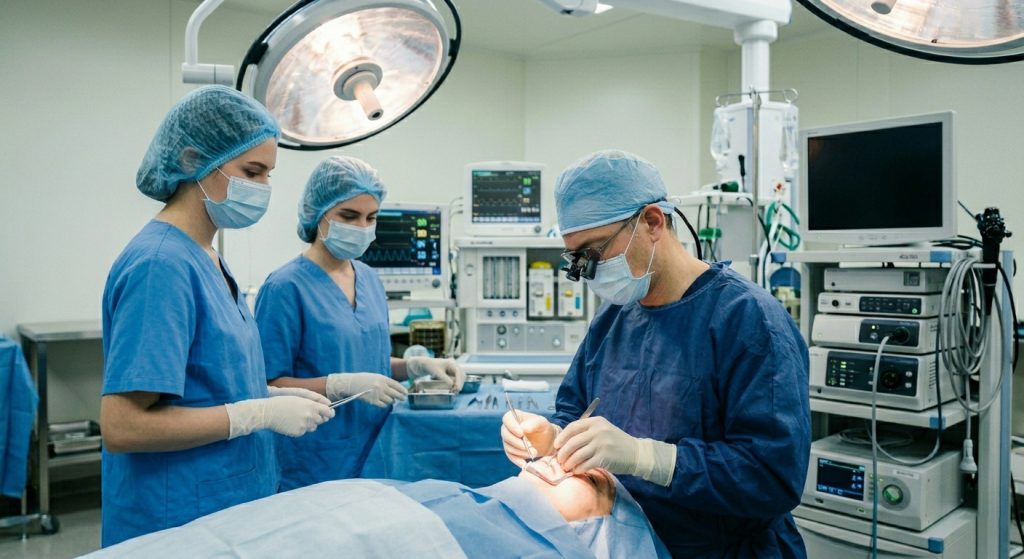
Because OMS surgeons are dual-qualified in both dentistry and medicine, they have a unique edge. They can perform complex surgeries like facelifts (rhytidectomy), nose jobs (rhinoplasty), and eyelid surgery (blepharoplasty), often while they are already doing functional reconstructions.

What exactly do Oral and Maxillofacial Surgeons do?
In short, they are the “architects” of the face. While a general plastic surgeon might focus on the skin, an OMS surgeon starts from the bone and works outward. They handle everything from correcting birth defects and repairing facial trauma to removing tumors and performing elective aesthetic enhancements. Their deep understanding of how the jaw affects the rest of the face makes them uniquely qualified for “Total Face” transformations.
Key Aspects of Cosmetic Maxillofacial Surgery:
- Core Procedures: The most common ones include facelifts, eyelid surgery, nose reshaping, brow lifts, and neck liposuction.
- A Unique Focus: Their specialized training allows them to work on the hard bony structures (like chin or jaw contouring) and the soft tissues of the face and neck at the same time.
- Function Meets Beauty: Cosmetic work often goes hand-in-hand with functional surgery, like orthognathic surgery (correcting a misaligned jaw) or reconstruction after cancer or an accident.
- Rigorous Training: Cosmetic facial surgery isn’t an “extra”; it’s taught during residency and is a key part of board exams.
- Teamwork: OMS surgeons often work with ENT specialists and plastic surgeons to give patients the most comprehensive care possible.
Common Cosmetic Procedures in OMS:
- Blepharoplasty: Fixing “tired eyes” by removing excess skin and fat from the eyelids.
- Rhinoplasty: Reshaping the nose to look better and often breathe better.
- Facelift: Tightening the skin and muscles to take years off a patient’s appearance.
- Genioplasty: Reshaping the chin to balance out the facial profile.
- Otoplasty: Fixing ears that stick out or have an irregular shape.
Based on a survey conducted on 102 CODA-accredited OMS programs, genioplasties and rhinoplasties were the most common facial cosmetic surgery procedures tallied.
The demand for these surgeries is booming because people care more than ever about facial aesthetics, our population is aging, and technology is making these procedures safer and better.
What’s the difference between a Plastic Surgeon and an OMS?
The main difference is the starting point. Most plastic surgeons come from a general surgery background. However, an OMS surgeon spends years focusing exclusively on the head, neck, and face. Because they understand the “foundation” (the bite and the facial skeleton), they are often better at predicting how soft tissue—like your skin and muscles—will react to changes in the bone structure.
Career in Oral and Maxillofacial Surgery
Choosing a narrower focus than general dentistry is a smart move for career stability. While general dentists might branch out into simple root canals or implants, they face significant limitations. When you become an OMS surgeon, your skillset far surpasses that of a general dentist. You are trained to handle facial deformities, head and neck cancers, and severe malocclusions that simple orthodontics can’t touch.
You’ll also be an expert in anesthesia, airway maintenance, and intubation—techniques most dental practices simply aren’t equipped for. This makes you more in demand with far fewer competitors. In fact, many aesthetic plastic surgeons actually seek out specialized OMS training to incorporate more transformative procedures into their own practices.
Exploring Sub-Specialty Options
Many surgeons choose to narrow their focus even further through fellowship training after their residency:
- Facial Cosmetic Surgery: Performs transformative procedures like rhinoplasty, ear reconstruction, and various facelift techniques to restore both look and function.
- Cleft and Craniomaxillofacial Surgery: Focuses on treating congenital issues like cleft lip and palate. These complex cases offer life-changing results, often for small children.
- Head and Neck Oncology: Treats tumors in the mouth, throat, and salivary glands. Since these cancers can be disfiguring, the training includes a heavy focus on reconstructive surgery.
High Income Generation
Specialized expertise pays off. According to U.S. News, oral and maxillofacial surgery ranked as the #5 best-paying job and #7 best healthcare job in 2022. While salaries vary, you can generally expect to be very well-compensated for your high level of skill.
Conclusion
The data shows that Oral and Maxillofacial surgeons are becoming the go-to experts for facial aesthetics. In fact, research (like the 5-year study from 2011-2016) shows that many OMS residency programs actually exceed the requirements of traditional medical specialties when it comes to facial cosmetic procedures. Whether it’s a 4-year or a 6-year dual-degree program, OMS surgeons are graduating with massive amounts of hands-on experience.
References:
https://pubmed.ncbi.nlm.nih.gov/30921155
https://www.aboms.org/news/why-consider-career-oral-and-maxillofacial-surgery
Ready to elevate your facial aesthetics training? Our Facial Injection Training Model and Clear Facial Injection Mannequin Head Model give OMS surgeons and cosmetic practitioners a zero-risk environment to rehearse technique and build haptic muscle memory. Browse the full range on our Aesthetic Facial & Lip Filler Models page.
🩺 Recommended Training Tools
- Facial Injection Training Model — Life-size head with realistic skin and wrinkle zones for Botox and filler practice.
- Clear Facial Injection Mannequin Head Model — Transparent design for visualizing needle depth during scalp and facial procedure training.
- Clear Facial Injection Model with Arteries, Veins and Nerves — Visible vascular mapping for safe injection technique education.
Disclaimer: This article is for educational purposes only and is not a substitute for professional medical advice, diagnosis, or treatment. Always consult a qualified healthcare professional. Last updated: June 2026.