When you or someone you care for develops a pressure ulcer (also called a bedsore or pressure injury), one of the first questions is: how long will it take to heal? There is no single answer. Recovery depends mainly on the stage of the ulcer, but also on the person’s overall health and the quality of care. A mild Stage 1 ulcer may resolve in days, while a deep Stage 4 wound can take many months—or, in severe cases, may never fully heal without surgery.
This guide explains how pressure ulcers form, how quickly they appear, the typical healing time at each stage, and what actually speeds recovery. If you want to catch a bedsore before it ever reaches these stages, start with our companion guide on pressure injury early warning signs.
How Do Pressure Ulcers Form—and How Fast?
A pressure ulcer is damage to the skin and underlying tissue caused by sustained pressure, often combined with shear and friction. The constant pressure squeezes small blood vessels shut—once it exceeds the capillary filling pressure of roughly 32 mm Hg, blood flow stops, the tissue is starved of oxygen, and cells begin to die. They most often develop over bony areas such as the heels, hips, tailbone, sacrum, and elbows, in people who are bedridden, use a wheelchair, or have limited mobility.
They can form remarkably fast. In an at-risk person, tissue damage can begin after as little as 2 hours of unrelieved pressure—which is why repositioning every 2 hours (and every 15–30 minutes in a chair) is the cornerstone of prevention.
Once a wound forms, healing moves through three overlapping phases—inflammation, proliferation (rebuilding tissue), and remodeling (strengthening). Deeper wounds must rebuild more tissue through these phases, which is the basic reason higher-stage ulcers take so much longer to heal.
Pressure Ulcer Healing Time by Stage
The recovery timeline depends largely on how deep the ulcer goes. The table below gives typical ranges with good care; individual healing can be faster or slower depending on health and circumstances.
| Stage | What it looks like | Typical healing time |
|---|---|---|
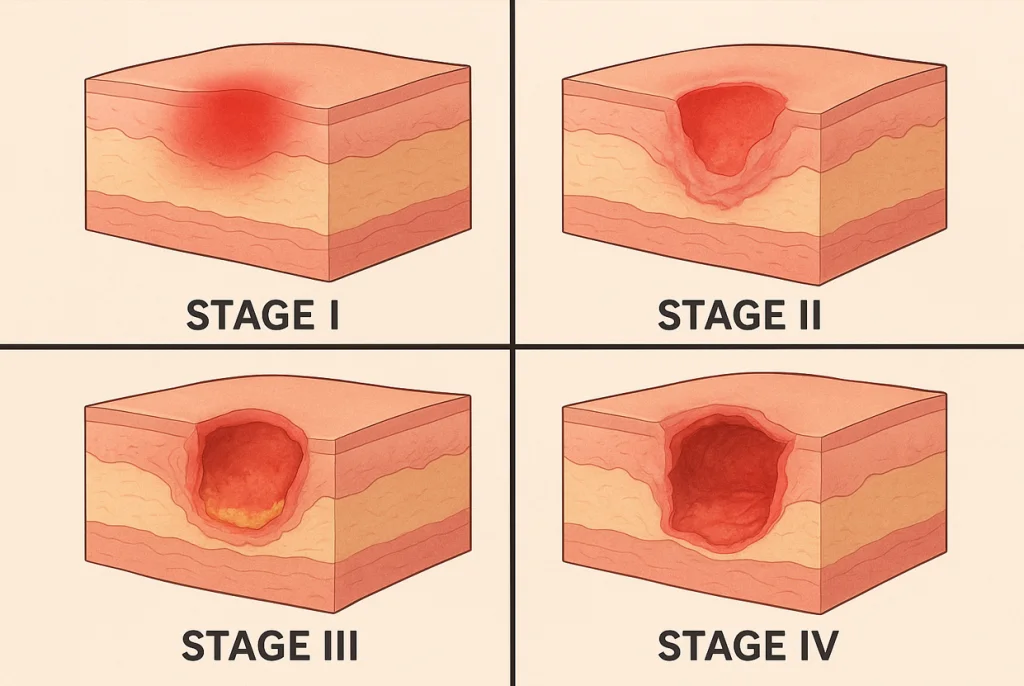
| Stage 1 | Intact skin with non-blanchable redness or discoloration (purple/blue on darker skin) | A few days to ~1 week |
| Stage 2 | Partial-thickness skin loss; blister or shallow open sore | ~1 to 3 weeks |
| Stage 3 | Full-thickness loss into fat tissue; crater-like wound | ~1 to 4 months |
| Stage 4 | Deep loss exposing muscle, tendon, or bone | Several months to over a year |
Stage 1 (mild redness or discoloration)
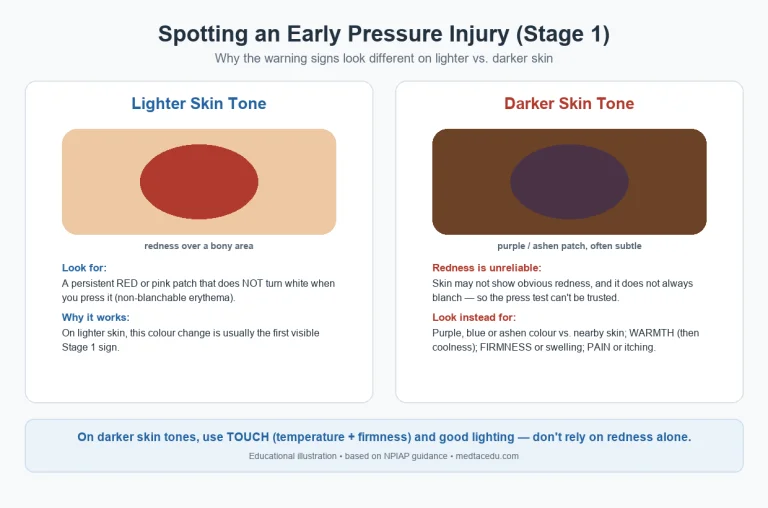
The earliest pressure ulcers. The skin is not broken, but there is non-blanchable redness—or purple/blue discoloration on darker skin tones—that does not fade when pressed. With prompt care (frequent repositioning, cushioning, and keeping skin clean and dry), these can heal within a few days to a week.
Stage 2 (blisters or shallow open wounds)
The skin is now damaged, forming a blister or shallow sore that exposes the dermis. Healing usually takes 1 to 3 weeks, depending on how quickly pressure is relieved and whether the wound stays clean and protected.
Stage 3 (deeper wounds into fat tissue)
The ulcer extends through the skin into the fat layer, creating a crater-like wound that may have tunneling. Healing typically takes 1 to 4 months, and the infection risk rises significantly. Specialized wound care—debridement (removal of dead tissue) and medical dressings—is usually required.
Stage 4 (severe ulcers into muscle or bone)
The most serious pressure ulcers, reaching muscle, tendon, or bone. Healing may take several months to more than a year, and complete healing sometimes requires surgery such as skin grafts or flap reconstruction. Stage 4 wounds carry the highest risk of life-threatening complications and need intensive medical management.
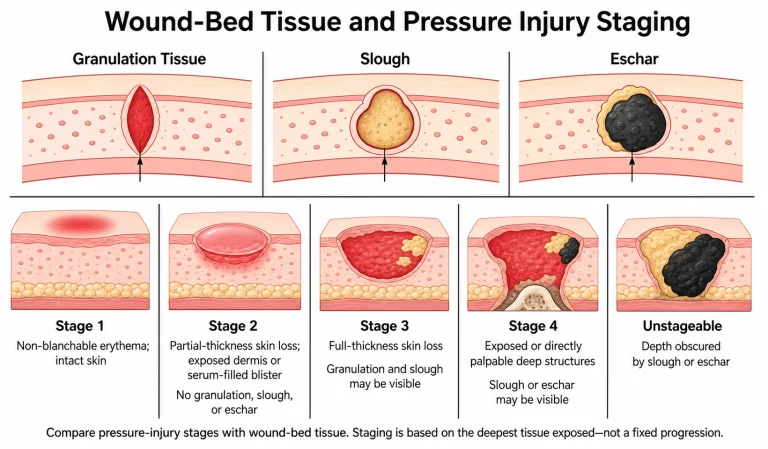
Note: “Unstageable” ulcers (covered by dead tissue) and “deep tissue injuries” (persistent deep red, maroon, or purple skin) cannot be given a reliable timeline until the wound is cleaned or fully declares itself.
Factors That Affect Healing Time
Even within the same stage, healing time varies widely. The biggest factors are:
- Nutrition — often the single most reversible factor. Healing tissue needs plenty of protein, vitamin C and zinc (for collagen formation), and iron (for oxygen transport). People with large wounds may need substantially more calories than usual to keep up with the demands of healing.
- Circulation and overall health — diabetes, vascular disease, and a weakened immune system all slow healing by reducing blood and oxygen supply to the wound.
- Infection — infected wounds heal far more slowly, and a systemic infection is a serious, potentially life-threatening complication. Watch for increasing pain, warmth, swelling, odor, or drainage.
- Moisture — incontinence or sweat keeps skin continually damp, leading to maceration and breakdown that delays healing.
- Mobility and ongoing pressure — if the wound keeps getting compressed, it cannot heal. Consistent offloading is essential.
How to Support Faster Healing
While timelines vary, the right care plan makes a real difference:
- Relieve pressure consistently — reposition at least every 2 hours in bed and every 15–30 minutes in a chair, and use pressure-redistributing mattresses, cushions, or heel protectors.
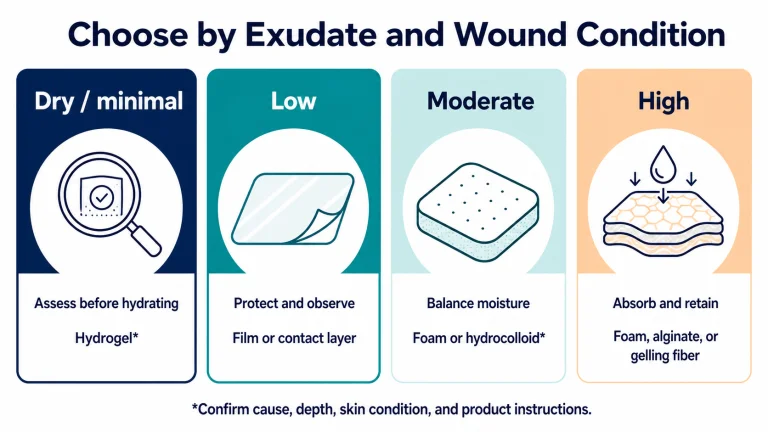
- Keep the wound in a moist, protected environment — modern dressings such as hydrocolloids and hydrogels support healing far better than letting a wound dry out.
- Remove dead tissue (debridement) — clearing slough and eschar allows healthy tissue to rebuild; this should be done by a clinician using the appropriate method.
- Consider advanced therapies for deep wounds — options such as negative pressure wound therapy (NPWT) can reduce edema and stimulate circulation in Stage 3–4 ulcers.
- Optimize nutrition and hydration — ensure adequate protein, calories, vitamins, and fluids.
- Get professional wound care — nurses, wound specialists, and physical therapists can tailor treatment and monitor progress. A superficial ulcer that shows no improvement within about two weeks of good care should be reassessed.
Prevention Is Still the Best Medicine
Because severe pressure ulcers can take months to heal, prevention is always the better path. Establish a regular repositioning schedule, support good nutrition and hydration, manage moisture, and use pressure-relieving equipment for at-risk individuals. Above all, check the skin daily and act on the earliest sign—relieving pressure on a small Stage 1 mark can stop it from ever becoming a deep, slow-healing wound. Learn exactly what to look for in our guide to spotting pressure injuries early (including on darker skin).
Frequently Asked Questions
Can a Stage 1 pressure ulcer heal on its own?
Often, yes—if it is caught early. Because Stage 1 skin is still intact, removing all pressure from the area, keeping the skin clean and dry, and repositioning frequently usually allows it to resolve within a few days to a week. The key is acting immediately: left under continued pressure, a Stage 1 mark can progress into an open wound.
Why do Stage 3 and 4 ulcers take so long to heal?
Deeper wounds have to rebuild far more tissue through the inflammation, proliferation, and remodeling phases, and they face a much higher risk of infection. Stage 3 reaches into the fat layer and Stage 4 into muscle or bone—so these wounds can take months to over a year, and sometimes need surgery such as skin grafts or flap reconstruction.
Can a pressure ulcer be treated at home?
Early ulcers (Stage 1 and some Stage 2) can often be managed at home with proper pressure relief, gentle skin care, and appropriate dressings—ideally with guidance from a nurse or clinician. Stage 3 and 4 wounds need professional wound care and should always be assessed by a healthcare provider.
What foods help pressure ulcers heal faster?
Healing tissue is hungry for protein (meat, eggs, dairy, beans), vitamin C (citrus, peppers, berries), zinc (meat, seeds, legumes), and iron, plus enough overall calories and fluids. If appetite is poor or the wound is large, a dietitian can recommend supplements or higher-calorie strategies.
How can I tell if a pressure ulcer is healing or getting worse?
Signs of healing include the wound gradually shrinking, pink healthy tissue at the edges, and less drainage over time. Warning signs of worsening or infection include increasing pain, redness or warmth spreading around the wound, swelling, a foul odor, pus, or fever. If you notice these, seek medical care promptly.
Conclusion
So, how long does it take for a pressure ulcer to heal? Anywhere from a few days for Stage 1 to many months—or longer—for Stage 4, depending on the depth of the wound and the person’s health. Stages 1 and 2 often heal quickly with prompt, consistent care, while Stages 3 and 4 require intensive treatment and time. By combining pressure relief, good wound care, solid nutrition, and—best of all—prevention, you can significantly improve the odds of a faster recovery.
For nursing educators and clinical trainers, hands-on practice with a Pressure Ulcer Model 4 Stages Kit helps learners visualize each stage—from mild redness to deep tissue damage—and build the assessment skills needed for timely intervention. Complement wound-care training with the 5 Stages of Diabetic Foot Ulcer Model Set for patients at higher risk. Explore the full range on our Wound Care, Ulcer & Stoma Models page.
🩺 Recommended Training Tools
- Pressure Ulcer Model 4 Stages Kit — Visualize all four pressure ulcer stages on realistic skin tissue for accurate clinical assessment training.
- 5 Stages of Diabetic Foot Ulcer Model Set — Five-stage progression model ideal for teaching diabetic wound care alongside pressure ulcer prevention.
References & Further Reading
- NurseTogether — Pressure Ulcers Nursing Diagnosis & Care Plan (nursetogether.com)
- Nurseslabs — Pressure Ulcer (Bedsores) Nursing Care Plans (nurseslabs.com)
- Wounds International — A Quick Guide to Pressure Injury Management (woundsinternational.com)
- National Pressure Injury Advisory Panel (NPIAP) (npiap.com)
- Merck Manual — Pressure Injuries (merckmanuals.com)
Disclaimer: This article is for educational purposes only and is not a substitute for professional medical advice, diagnosis, or treatment. Always consult a qualified healthcare professional. Last updated: June 2026.