A dog that suddenly refuses to use one leg may have a fracture, but severe sprains, joint dislocations, torn ligaments, paw injuries, and neurologic problems can look similar. You cannot reliably confirm or rule out a broken bone by watching the dog walk or gently feeling the leg at home.
A dog leg fracture — a broken leg — is a painful injury that needs prompt veterinary assessment. Some fractures cause an obvious deformity or open wound. Others are aligned, incomplete, or hidden beneath swelling and may look like “just a limp.”
This guide explains which bones dogs commonly break, which dogs face greater risk, the main fracture types, warning signs, what a veterinarian checks, and how to move an injured dog without making the damage worse.
This article is for general education. It cannot diagnose an individual dog. If trauma has occurred or a fracture is possible, restrict movement and contact a veterinarian or emergency hospital promptly.
When a Limp Could Mean a Broken Leg
Suspect a fracture when a dog suddenly will not bear weight, holds the leg up, develops marked swelling, has an abnormal leg angle, or has a wound near the painful area—especially after a fall, collision, or vehicle accident.
Some dogs can still touch the foot down with a small, stable, or incomplete fracture. Others may hide pain. Walking does not rule out a break, and an X-ray is usually needed to tell a fracture from a dislocation or severe soft-tissue injury.
Until a veterinarian assesses the dog:
- keep movement to a minimum;
- call the clinic or emergency hospital;
- cover an open wound loosely with clean gauze; and
- do not straighten, massage, or tightly wrap the leg.
What Is a Dog Leg Fracture?
A fracture is a break in the normal continuity of a bone. It may be a fine crack, a partial break, or a complete separation into two or more fragments.
The leg also contains joints, muscles, tendons, ligaments, nerves, and blood vessels. A fracture can injure several of these structures at once. High-energy trauma can also cause chest, abdominal, head, or spinal injuries that are more immediately dangerous than the broken limb.
According to the American College of Veterinary Surgeons (ACVS), dogs with a fractured limb commonly hold it up, while dogs involved in major trauma may have multiple injuries and may be unable or unwilling to walk.
Common Causes of Broken Legs in Dogs
The amount of force required to break a bone depends on the dog’s age, bone health, body size, and the direction of the load.
Common causes include:
- being struck by a vehicle;
- falling from a height;
- being stepped on or caught in a door;
- rough play, collision, or twisting at speed;
- a bite or other penetrating injury;
- jumping from furniture, especially in toy breeds or young puppies;
- repetitive loading that contributes to a stress fracture; and
- weakened bone caused by a tumor, infection, or metabolic disease.
An apparently minor incident can still produce a serious fracture in a puppy, a very small dog, or a dog whose bone has already been weakened by disease.
Which Bones Do Dogs Commonly Break?
Any bone can fracture. In dogs with limb injuries, veterinarians commonly evaluate:
- the radius and ulna, the two bones between the front elbow and wrist;
- the tibia and fibula, between the back knee and hock;
- the femur, or thigh bone;
- the metacarpal, metatarsal, and toe bones in the feet; and
- the pelvis, especially after a vehicle strike, crush injury, or major fall.
The Royal Kennel Club also identifies the femur and pelvis as frequently broken and notes that major trauma may fracture the skull, jaw, or spine. These injuries require whole-body assessment, not just a leg X-ray.
Which Dogs Are More Likely to Break a Bone?
All breeds can sustain a fracture. Risk depends on age, size, activity, trauma exposure, and bone health.
- Puppies and young, adventurous dogs may fall, collide during play, or injure a still-developing growth plate. Even an incomplete fracture can affect future limb growth.
- Toy and miniature dogs need extra care around beds, sofas, arms, and stairs. Their distal radius and ulna are vulnerable after a fall or jump; a biomechanical study found that toy-breed forearm geometry can increase susceptibility under proportional loading.
- Older dogs may fall more easily because of changes in strength, vision, balance, or mobility. Very minor trauma should also prompt assessment for underlying bone disease.
- Dogs with weakened bone from a tumor, infection, metabolic disorder, or nutritional bone disease can develop a pathologic fracture with much less force than healthy bone.
- Fast, highly active, or working dogs have greater exposure to collisions, twisting, repetitive loading, and hard landings. This does not mean their bones are naturally weak.
Higher risk does not prove that a limp is a fracture, but it should lower the threshold for veterinary assessment.
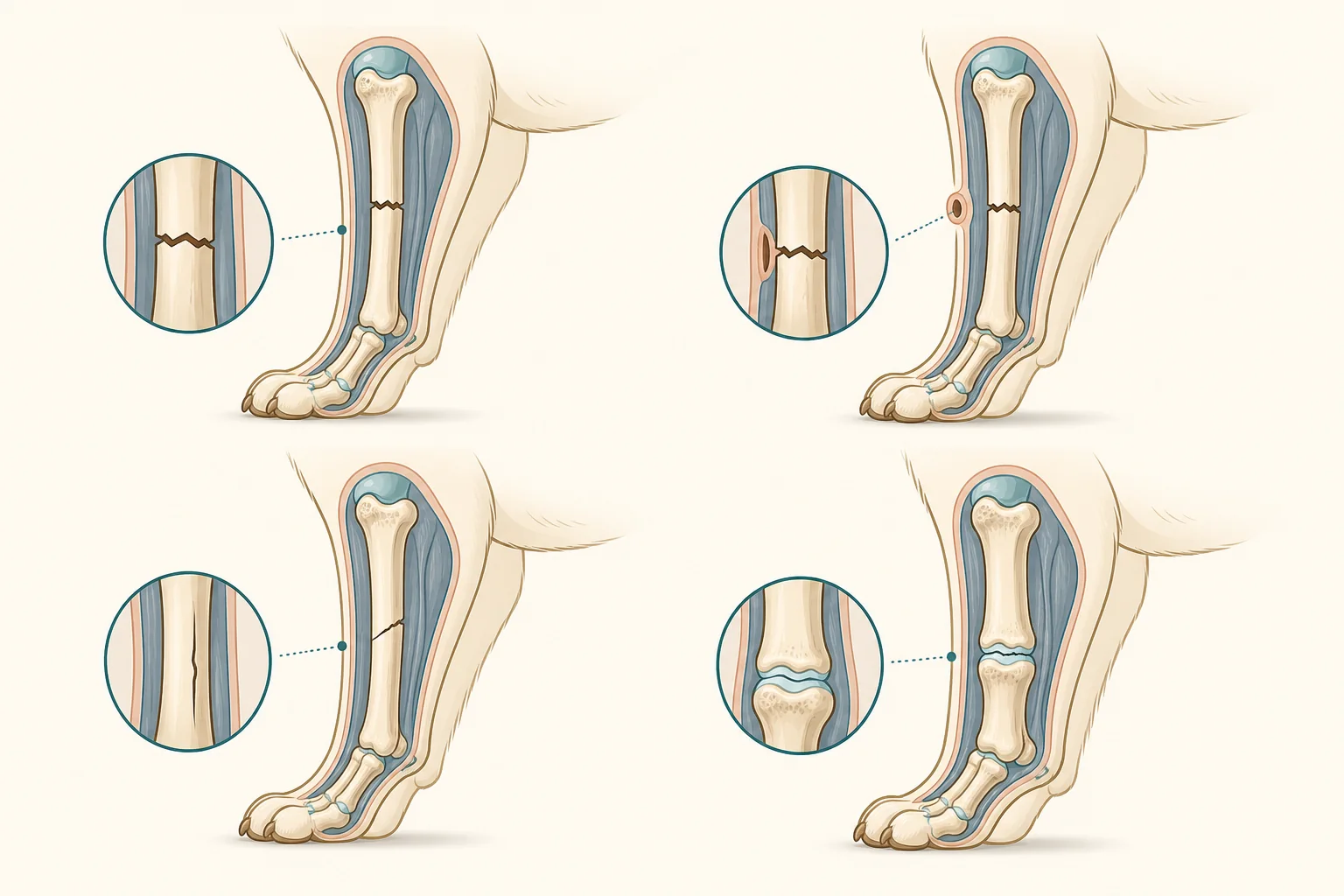
Four Dog Fracture Types Owners Need to Understand
Veterinarians use many technical terms on X-ray reports, but owners do not need to memorize every fracture-line shape. These four distinctions explain most of the urgency and treatment conversation:
| Fracture description | Plain-language meaning | Why it matters |
|---|---|---|
| Open or closed | An open fracture connects to a skin wound; a closed fracture does not | Open fractures are urgent because contamination and infection risk are higher |
| Complete or incomplete | A complete break crosses the whole bone; an incomplete fracture is a crack or partial break | An incomplete fracture may have no obvious deformity, but it can still worsen |
| Displaced or nondisplaced | Displaced fragments have shifted out of normal alignment; nondisplaced fragments remain aligned | Displacement affects stability and whether external support or surgery may be needed |
| Growth plate fracture | The break involves a developing area near the end of a puppy’s bone | It may affect future limb growth or joint function |
Open fractures need special urgency
Bone does not have to protrude for a fracture to be open. A small puncture near the break may create a path for bacteria. Treat any wound near a suspected fracture as urgent, cover it loosely with a clean dressing, and do not push tissue or bone back under the skin.
A “small crack” is still a fracture
Hairline, stress, and greenstick fractures are incomplete breaks. They may cause less deformity and sometimes allow partial weight bearing, but they still need veterinary assessment and protection from further loading.
Puppy fractures deserve prompt assessment
Growth plates are softer regions of developing bone. Merck Veterinary Manual guidance on joint and growth plate trauma notes that injuries in these areas may affect future limb development. A limping puppy should not be encouraged to “walk it off.”
You may also see terms such as transverse, oblique, spiral, comminuted, avulsion, or articular on a veterinary report. These describe the fracture line, fragment number, or joint involvement and help the surgeon plan repair. They are not categories an owner needs to identify at home.
Dog Leg Fracture Symptoms
Signs vary with the bone involved, fracture stability, displacement, soft-tissue damage, and the dog’s pain response.
The most useful signs for owners are:
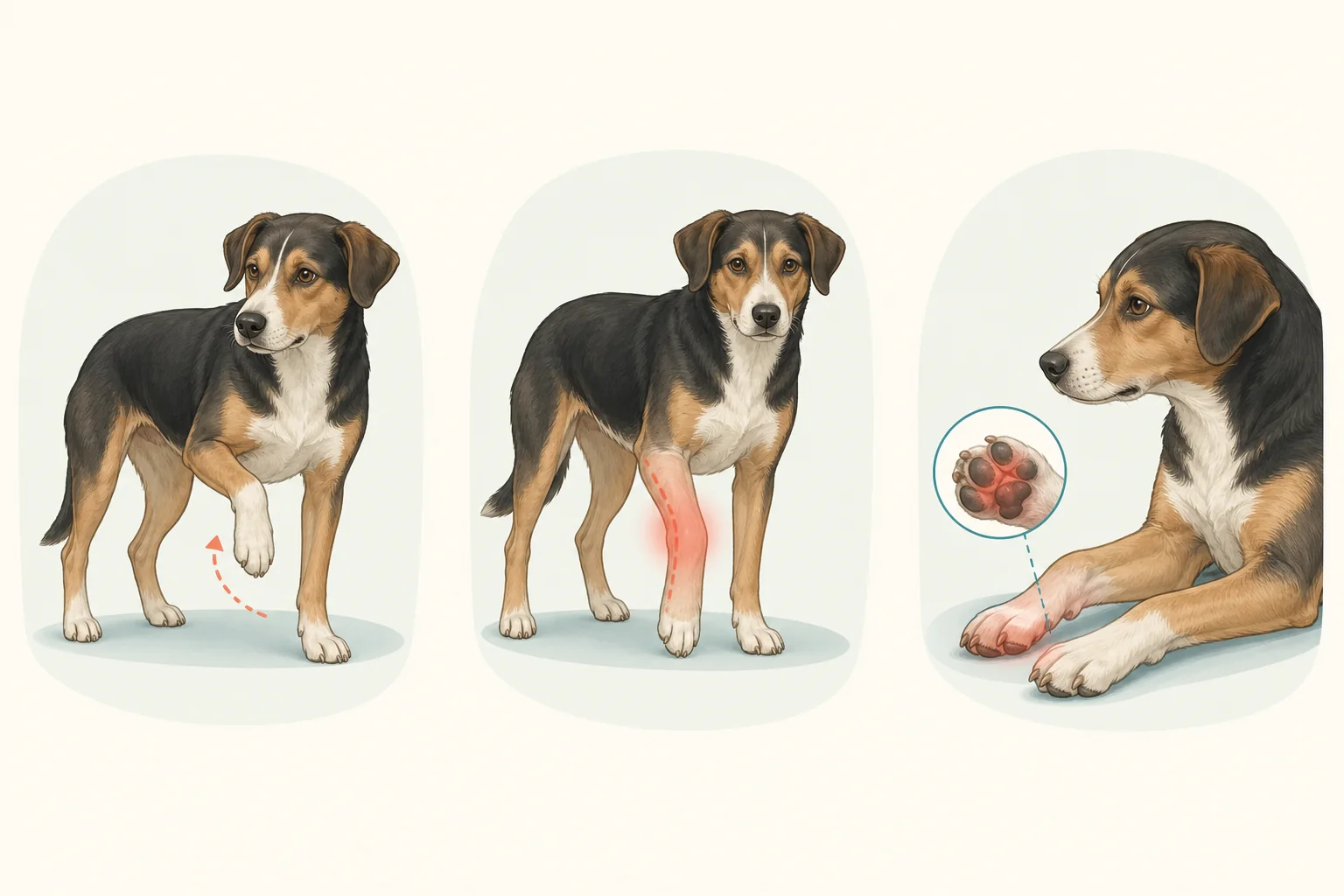
- suddenly refusing to bear weight or holding the leg up;
- severe or persistent limping after an accident;
- pain shown by crying, panting, trembling, hiding, or guarding;
- swelling, bruising, or an abnormal leg angle;
- a wound or bleeding near the painful area;
- dragging or knuckling the paw; and
- reluctance to stand or walk after trauma.
Not every dog will cry, and some dogs can still touch the foot down with a stable or incomplete fracture. The ability to take a few steps does not rule out a broken bone.
Signs That Require Emergency Care
Go to an emergency veterinary hospital promptly when:
- bone is visible or a wound lies near the suspected break;
- the leg is severely deformed, dangling, or rapidly swelling;
- the paw is cold, pale, blue, very swollen, or has no apparent sensation;
- bleeding does not stop with gentle direct pressure;
- the dog cannot stand or more than one limb may be injured;
- the injury followed a vehicle strike, major fall, crushing event, or other high-energy trauma;
- breathing is difficult, the gums are pale, the abdomen is distended, or the dog collapses;
- there is weakness, paralysis, altered awareness, or possible spinal injury; or
- pain is severe or worsening.
After a major accident, a dog may have internal injuries even if the leg is the most visible problem.
Why Symptoms Alone Cannot Confirm a Fracture
Fractures, joint dislocations, ligament injuries, muscle or tendon injuries, and painful paw wounds can all cause limping, swelling, and reluctance to walk. Dragging or knuckling may also indicate nerve damage.
An abnormal angle, open wound, or obvious instability makes a fracture more likely, but the absence of those findings does not make the leg safe. Repeatedly bending or squeezing the limb cannot distinguish these injuries and may increase pain or move unstable fragments. A veterinary examination and X-rays provide the useful answer.
Broken Leg vs Sprain: How to Tell the Difference
Owners often ask how to tell whether a dog’s leg is broken or just sprained. The honest answer is that you cannot confirm it at home — a sprain, a torn ligament, and an incomplete fracture can all produce a limp, swelling, and a raised paw. Only a veterinary examination and X-rays separate them reliably. What you can judge at home is how urgently the dog needs to be seen.
A few patterns make a break more likely and should lower your threshold for an emergency visit:
- Weight bearing: a dog with a mild sprain will often still touch the toe down or carry a little weight within a short time; a dog that will not place any weight on the leg after the first few minutes is more concerning.
- Where the pain is: sprain pain tends to center on a joint and ease with rest; pain over the length of a bone, or pain that keeps worsening, is more suspicious for a fracture.
- Shape of the leg: an abnormal angle, a leg that looks shorter or rotated, obvious instability, or a wound near the sore area points strongly toward a fracture and needs urgent care.
None of these signs is reliable on its own, and a calm, partly weight-bearing dog can still have a stable fracture. When in doubt, restrict movement and let a veterinarian make the call — repeatedly flexing or squeezing the leg to “test” it only adds pain and can shift an unstable break.
What to Do Before Reaching the Veterinarian
1. Restrict movement and call ahead
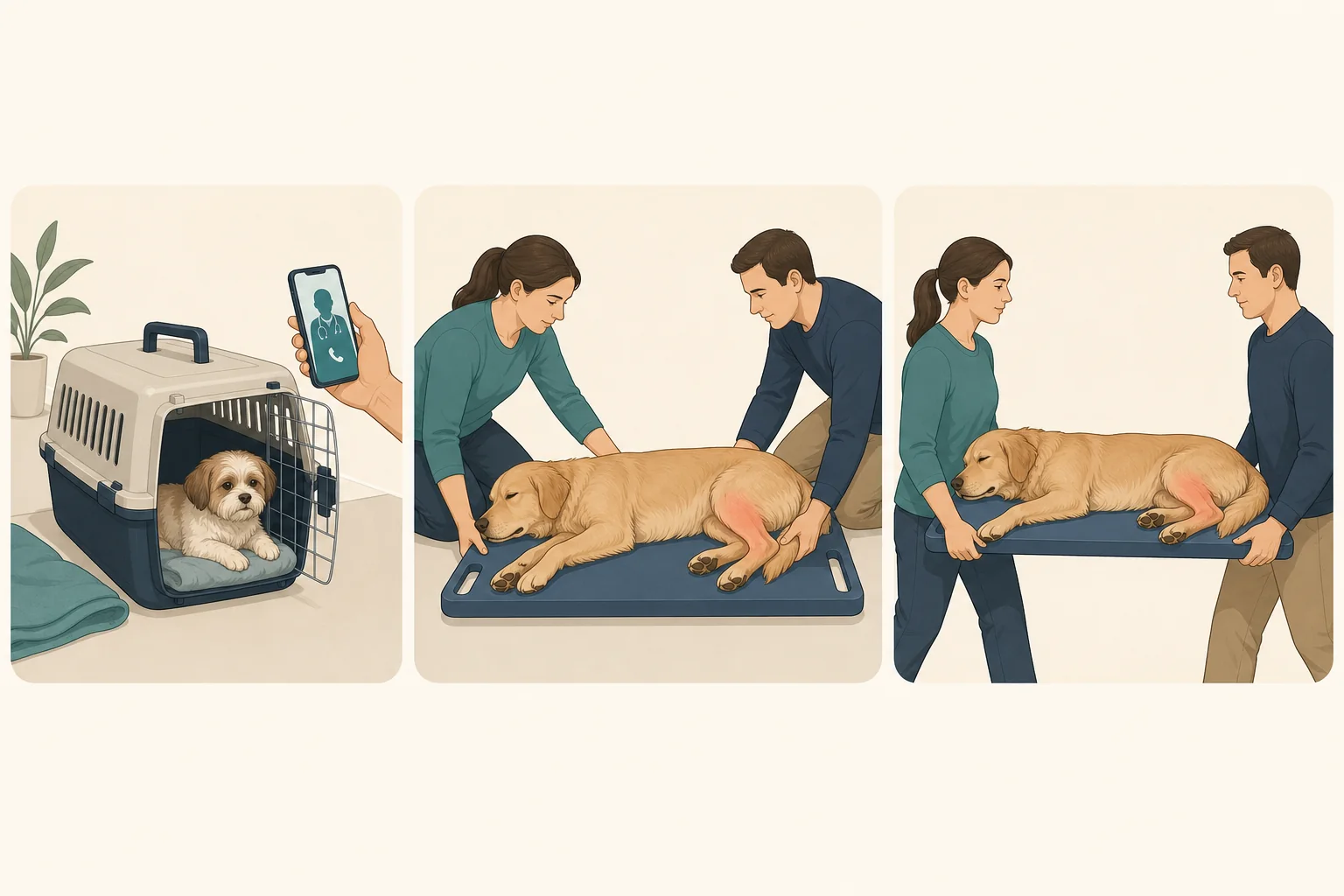
Place a small dog in a carrier or sturdy box. Keep a larger dog lying in a confined area and use several people to move the dog when possible.
The ACVS recommends confinement to a very small space and movement only when necessary until veterinary care is available.
Tell the clinic what happened, whether the dog can stand, whether there is a wound, and whether breathing or consciousness has changed. The clinic can advise on transport and prepare for arrival.
2. Protect an open wound
If there is bleeding, apply gentle direct pressure with clean gauze or cloth unless bone is protruding. Loosely cover an open wound with a clean dressing. Do not scrub deeply, probe the wound, or push bone back into place.
3. Move the whole body safely
For a large dog or major trauma, slide the dog onto a rigid board, folded blanket, or other supportive surface. Keep the body aligned and minimize twisting.
Pain and fear can make a normally gentle dog bite. Keep your face and hands away from the mouth. Do not muzzle a dog that is vomiting, struggling to breathe, unconscious, or has facial trauma.
4. Do not improvise treatment unless directed
Do not pull the leg straight, attempt fracture reduction, massage the area, or apply heat. Do not give human painkillers or leftover veterinary medication. The ACVS advises giving no medication or therapy unless a veterinarian has provided clear instructions.
The American Veterinary Medical Association’s first-aid guidance warns that a poorly applied bandage or splint can do more harm than good. Unless a veterinarian instructs you and transport is genuinely delayed, confinement and careful movement are safer than improvised tight wrapping.
How a Veterinarian Diagnoses a Dog Leg Fracture
Triage comes first
After major trauma, the team first evaluates breathing, circulation, neurologic status, pain, and evidence of internal injury. A visibly broken leg may not be the first problem treated.
Orthopedic and neurovascular examination
The veterinarian assesses swelling, wounds, alignment, joint stability, pain, nerve function, paw warmth, pulses, and circulation. Pain relief or sedation may be needed before a complete examination.
Radiographs
X-rays usually confirm the fracture and show its location, pattern, displacement, and joint involvement. Images commonly include the bone and the joints above and below it. Sedation or anesthesia may be required to position the limb without causing unnecessary pain.
Additional tests
Depending on the injury, the veterinarian may recommend:
- chest or abdominal imaging after major trauma;
- blood tests before anesthesia or surgery;
- CT for complex joint, pelvic, or other three-dimensional fractures;
- wound sampling or culture when infection is suspected; or
- evaluation for underlying bone disease when the trauma seems too minor to explain the break.
The diagnosis is more than “broken or not broken.” The full classification guides whether the dog needs temporary stabilization, a cast or splint, surgery, or another treatment plan.
For what happens after diagnosis, see the companion guide: Dog Broken Leg Treatment: Splinting, Surgery, and Recovery After a Leg Fracture.
Conclusion
A dog leg fracture can be obvious, but it can also look like a persistent limp with no visible deformity. Open wounds, severe swelling, abnormal alignment, inability to bear weight, major trauma, or changes in paw circulation require urgent veterinary care.
The safest response is to restrict movement, handle the dog carefully, avoid manipulating the leg, and obtain veterinary assessment and imaging. The bone involved, fracture type, stability, joint involvement, age, bone health, and associated injuries—not appearance or breed alone—determine the treatment plan.
Frequently Asked Questions
Should I wait until morning if my dog started limping after a jump?
Call a veterinarian or emergency service for triage rather than deciding from the limp alone. Immediate assessment is especially important when the dog will not bear weight, pain is marked, swelling is increasing, the leg looks abnormal, or the dog is very young. A dog that remains comfortable and weight-bearing may be directed to a scheduled examination, but that decision should follow professional triage.
Can a dog break a leg without a major accident?
Yes. Puppies and toy breeds may fracture a limb after a relatively low fall. A stress injury can develop with repeated loading, and a pathologic fracture can occur when disease has weakened the bone. When the force seems too small to explain the damage, the veterinarian may investigate bone health as well as the fracture.
Can a dog’s broken leg heal without surgery?
Some carefully selected fractures can heal with external support and strict restriction, but others require surgical fixation to restore alignment and stability. Bone, location, displacement, age, soft-tissue injury, and joint involvement all matter. The X-rays and orthopedic assessment—not the dog’s ability to walk—determine whether nonsurgical care is appropriate.
How can I tell if my dog’s leg is broken or just sprained?
You cannot tell for certain at home, because a bad sprain and an incomplete fracture look very similar. A dog that refuses any weight on the leg after the first few minutes, has pain over the length of a bone rather than a single joint, or shows an abnormal leg angle is more likely to have a fracture and should be seen urgently. A dog that quickly returns to partial weight bearing may have a soft-tissue injury, but only a veterinary examination and X-rays confirm the difference — avoid repeatedly bending the leg to test it.
Sources
- American College of Veterinary Surgeons: Fractured Limbs
- Merck Veterinary Manual: Bone Fractures in Dogs and Cats
- Merck Veterinary Manual: Joint Trauma in Dogs and Cats
- Merck Veterinary Manual: First Aid and Transport of Small Animals
- American Veterinary Medical Association: First Aid Tips for Pet Owners
- The Royal Kennel Club: Broken Bones
- Journal of Biomechanics via PubMed: Distal Radius and Ulna Geometry in Toy-Breed Dogs
Veterinary disclaimer: This article provides general educational information and is not a diagnosis or individualized treatment plan. A suspected fracture requires prompt assessment by a licensed veterinarian.
Training Resources
Fracture reduction and definitive orthopedic fixation require veterinary training, suitable imaging, and patient-specific planning. For supervised veterinary skills education, MEDTACEDU’s Dog IV Practice Kit can support practice in canine limb handling, dressing placement, and bandaging fundamentals before learners work with live patients. It is not a fracture-reduction simulator and does not replace orthopedic instruction.