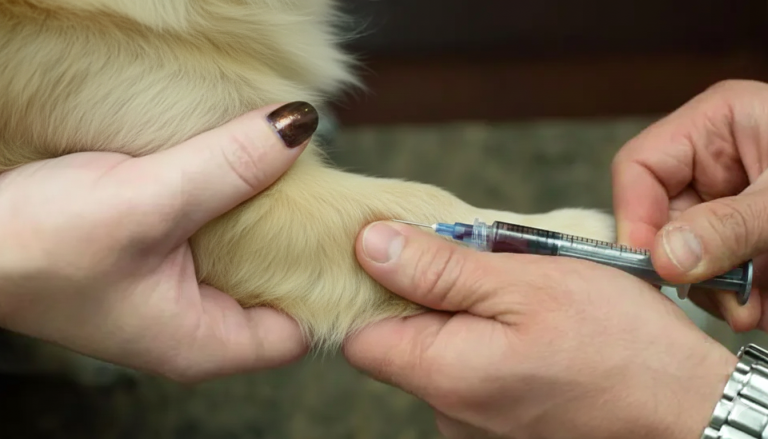
Many dogs need injections at some point — a diabetic dog requires daily insulin, an arthritic senior gets a monthly joint injection, and almost every dog receives vaccines. In day-to-day veterinary and at-home care, two routes do most of the work: subcutaneous (SC, under the skin) and intramuscular (IM, into the muscle). This guide explains when each route is used, which injections you can safely give a dog at home, how to do it correctly, and the risks to watch for.
A note on other routes: Intravenous (IV) injections deliver drugs straight into the bloodstream and are reserved for hospital and emergency use by trained staff — see our guide to canine IV catheterization. Intradermal injection (into the skin layer itself) is a specialist diagnostic technique for allergy skin-testing performed by veterinary dermatologists — it is not a routine way to medicate a dog, which is why this guide focuses on the two routes owners and clinicians actually use for giving medication: SC and IM.
Scope: This page compares medication injection routes. Canine jugular phlebotomy is blood collection — the canine venipuncture overview explains how a collection site is chosen — while IV catheter placement is vascular access; neither is an SC or IM medication-injection shortcut. Feline learners should use a species-specific Veterinary Cat IV Practice Kit for supervised cat IV and blood-draw practice.
Subcutaneous vs. Intramuscular: Quick Decision Table
Use this at-a-glance comparison to understand why your veterinarian chooses one route over the other.
| Subcutaneous (SC) | Intramuscular (IM) | |
|---|---|---|
| Where it goes | Loose tissue just under the skin | Into a large muscle |
| Absorption speed | Slow, steady (depot effect) | Faster — muscle has rich blood supply |
| Typical use | Insulin, many vaccines, allergy/immunotherapy, some long-acting parasite & arthritis drugs | Some vaccines, long-acting antibiotics, sedatives, certain joint drugs (e.g., Adequan) |
| Common site in dogs | Loose skin between/over the shoulder blades | Epaxial (lumbar) muscles beside the spine; quadriceps (front of thigh) |
| Pain / difficulty | Low — well tolerated, easiest to learn | Higher — more painful, more technique-sensitive |
| Suitable for home use? | Often yes, after veterinary training | Usually no — best left to professionals |
Subcutaneous (SC) Injections in Dogs
Subcutaneous injection places a small volume of medication into the loose connective tissue under the skin, where it is absorbed slowly and steadily. It is the most common route for at-home dog injections because the tissue is forgiving and the technique is straightforward.
When SC is used
- Insulin for diabetic dogs — given SC at home, often every 12 hours, depending on the prescribed insulin and treatment plan
- Many vaccines — vaccines may be licensed for SC or IM administration depending on the product, so follow the product label and local vaccination guidelines
- Allergy injections — allergen-specific immunotherapy (ASIT) and monoclonal anti-itch therapy (e.g., Cytopoint/lokivetmab) are SC
- Arthritis injections such as the monthly monoclonal antibody bedinvetmab (Librela) are given SC by the veterinary team
- Long-acting parasite injections (e.g., moxidectin/ProHeart for heartworm prevention)
- Some antibiotics and anti-nausea medications
Large-volume fluids for dehydration or kidney disease are also given subcutaneously, but that is a fluid-therapy technique with its own steps — see our dedicated guide to giving subcutaneous fluids to dogs at home.
How to give an SC injection (general technique)
- Confirm the drug, dose, and expiry; draw up the medication and expel air bubbles.
- Gently lift a fold of loose skin over the shoulder blades to make a “tent.”
- Insert the needle into the base of the tent, parallel to the body — not straight down (to avoid going through the other side).
- Briefly draw back on the plunger; if no blood appears, inject smoothly.
- Withdraw, release the skin, and reward your dog. Rotate sites for repeated injections (e.g., insulin) to protect the skin.
Pro tips for a clean SC injection
- Master the “tent.” Lift the skin into a clear triangular space and aim into the base of it. Too shallow and the drug stays in the skin; too deep and you reach muscle.
- Avoid the “wet injection.” A common mistake is pushing the needle in one side of the tent and straight out the other, leaving medication on the fur. Feel for the needle tip sitting inside the tent before you push the plunger.
- Rethink the “scruff.” The loose neck skin is easy but not always best. Modern guidance favors rotating sites — including the lower limbs for certain vaccines — so the skin stays healthy and any lump can be monitored.

Intramuscular (IM) Injections in Dogs
Intramuscular injection deposits medication deep into a muscle, where the rich blood supply produces faster absorption than SC. Because muscle is more sensitive and lies close to nerves and vessels, IM injections are more painful and more technique-dependent — they are generally given by veterinary professionals, not owners.
When IM is used
- Certain vaccines (some rabies products are licensed IM)
- Long-acting or irritant antibiotics that should not sit under the skin
- Sedatives and some pre-anesthetic drugs needing faster onset
- Certain joint medications such as polysulfated glycosaminoglycan (Adequan)
Preferred IM sites in dogs
- Epaxial / lumbar muscles beside the spine — a commonly used site (large muscle, away from major nerves). Site selection should consider the drug, the volume, the patient’s anatomy, and the training of whoever is giving the injection
- Quadriceps (front of the thigh) — easy to isolate
- Avoid the back of the thigh / gluteal area where the sciatic nerve can be injured

Two teaching aids are commonly used to build confidence with IM injections. They are training techniques rather than universally standardized clinical rules, and neither is a definitive way to confirm correct needle placement:
- The three-finger rule: use your fingers to find the “meat” of a large muscle (the epaxial muscles along the spine, or the quadriceps) so the needle stays well away from the sciatic nerve.
- The “muscle pop”: as the needle passes from skin into muscle you feel a slight give followed by firm, dense resistance — that change confirms the depth is right.
Follow the medication’s administration instructions and your clinic’s injection protocol regarding aspiration, since recommendations vary by drug, site, and current guidance. Inject slowly, and use the smallest effective needle.
Handling a Wiggly Dog: Restraint and Confidence
A dog is not a textbook — they move, flinch, and get nervous. A good injection is as much about handling the patient as handling the needle.
- Read body language. A dog that is “whale-eyeing” or tensing its muscles needs calming and a gentler approach than a relaxed one.
- Use a one-handed anchor. Learn to stabilize the limb and hold the skin “tent” with one hand while the other handles the needle, so the whole motion is quick and smooth.
- Practice on a model first. Rehearsing on a training model lets you fail safely and build muscle memory, so your hands are steady when you meet a real, wiggly patient.
Common Dog Injections, by Route
- Insulin injections for dogs — SC, twice daily, given at home after training; rotate sites and never change dose without your vet.
- Dog vaccination — most are SC; a few products are IM. Given by the veterinary team on a schedule.
- Allergy injection for dogs — immunotherapy (ASIT) or anti-itch monoclonals (Cytopoint) are SC; many owners are taught to continue ASIT at home.
- Dog arthritis injection — modern options like bedinvetmab (Librela) are SC and given monthly in-clinic; Adequan is IM.
- Flea / parasite injection for dogs — long-acting products (e.g., ProHeart) are SC and administered by your vet.
Can Pet Owners Give Dog Injections at Home?
Yes — for the right medications and after proper veterinary training. The key is matching the task to your skill and the drug to its correct route.
- ✅ Usually OK at home (SC): insulin, subcutaneous fluids, prescribed immunotherapy — all after a hands-on demonstration from your vet or nurse.
- ⚠ufe0f Case-by-case: some prescription SC medications, only if your vet has trained you on that specific drug.
- ❌ Leave to professionals: most IM injections, anything IV, vaccines, and any drug you have not been specifically trained to give.
Before your first at-home injection, ask your veterinary team to watch you do it once. Practicing the motion on a training model first builds confidence and protects your dog — a Dog IV & Injection Practice Kit lets students and owners rehearse needle handling before working with a live patient.
Risks and Warning Signs
Most injections are uneventful, but know what to watch for:
- Injection-site reactions: mild swelling, tenderness, or a small lump that usually resolves in a few days.
- Abscess or infection: from non-sterile technique — warmth, pain, discharge.
- Nerve or vessel injury (IM): why site selection and aspiration matter.
- Serious allergic reaction, including anaphylaxis: rare but urgent — facial swelling, hives, vomiting, or collapse within minutes of an injection can be signs of a serious allergic reaction and require immediate veterinary attention.
- Wrong dose or missed dose (especially insulin) — never “make up” a missed insulin dose; call your vet.
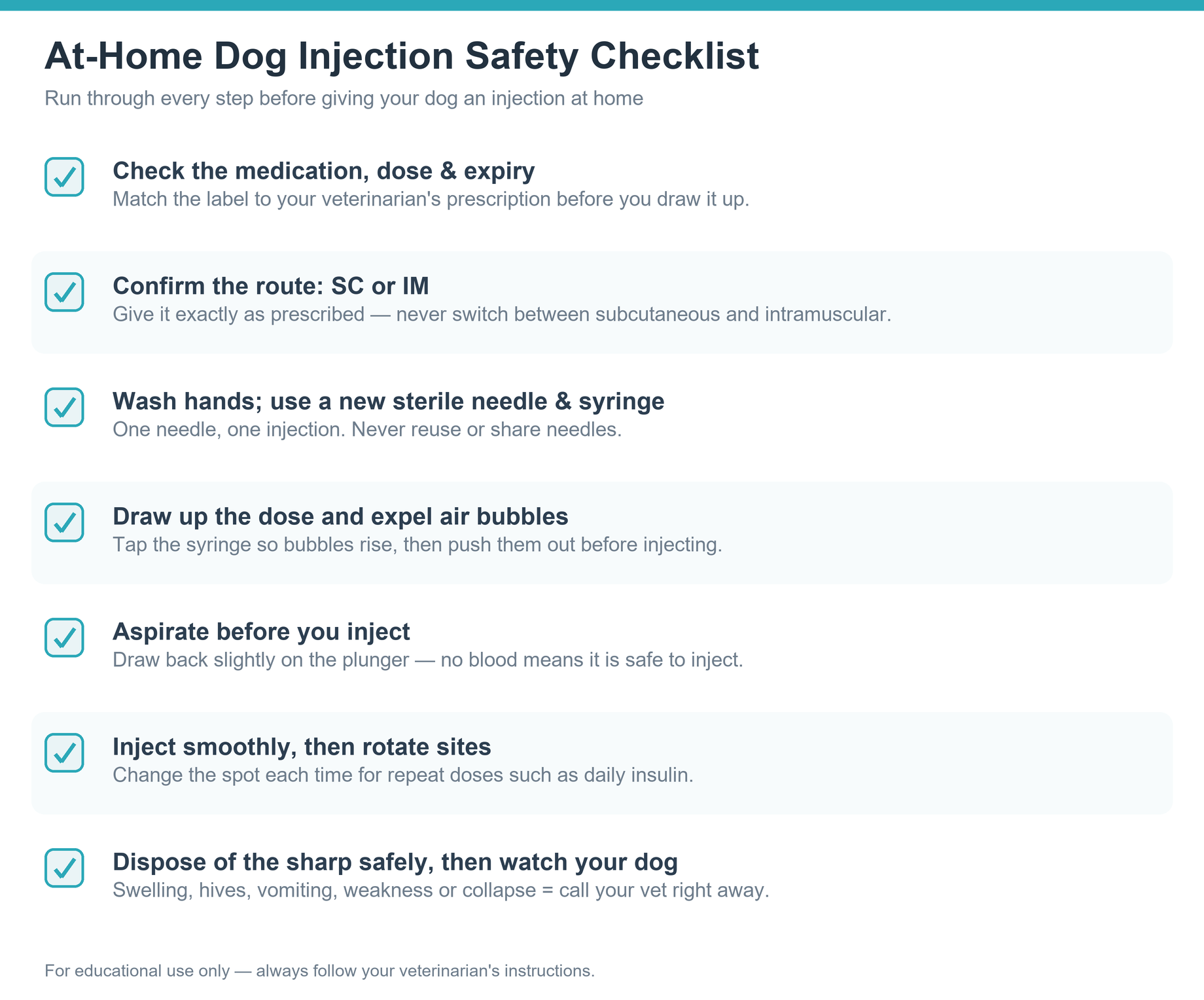
At-Home Dog Injection Safety Checklist
Run through this every time before giving an injection at home.
Frequently Asked Questions (FAQ)
What is the difference between SC and IM injection in a dog?
SC goes into the loose tissue under the skin and absorbs slowly; IM goes into muscle and absorbs faster but is more painful. SC is easier and safer for home use; IM is usually done by professionals.
Where do you give a subcutaneous injection on a dog?
Commonly into the loose skin over or between the shoulder blades, although site selection depends on the drug or product and your veterinarian’s instructions. Tent the skin, insert the needle parallel to the body, and inject. Routine aspiration is not generally necessary for SC injections and may cause unnecessary tissue trauma. Rotate sites for repeated injections.
Can I give my dog an intramuscular injection at home?
Generally no. IM injections are more painful and risk hitting nerves or vessels, so they are best left to your veterinary team unless they have specifically trained you for a particular medication.
Do dogs get intradermal injections?
Only for specialist allergy skin-testing performed by a veterinary dermatologist. Intradermal injection is a diagnostic tool, not a routine way to medicate a dog.
Is it safe to give a dog an insulin injection every day?
Yes — diabetic dogs receive SC insulin at home, often every 12 hours depending on the prescribed insulin and treatment plan, after the veterinary team trains you. Use the prescribed syringe type, rotate sites, and never adjust the dose on your own.
What should I do if my dog reacts badly after an injection?
A small, transient lump or mild local reaction can occur with some injections; not every injection should produce swelling. Facial swelling, hives, vomiting, weakness, or collapse can be signs of a serious allergic reaction, including anaphylaxis, and require immediate veterinary attention.
Sources
- MSD / Merck Veterinary Manual — Routes of Drug Administration
- VCA Animal Hospitals — Giving Injections to Dogs
- Plumb’s Veterinary Drug Handbook — administration routes
- WSAVA Vaccination Guidelines for Dogs
- Banfield Pet Hospital — Dog Vaccinations
Veterinary disclaimer: This article is for educational purposes only and does not replace professional veterinary advice. Always have a veterinarian diagnose your dog, prescribe medication, and demonstrate any injection technique before you attempt it at home. Medication routes and doses vary by product and patient.
Veterinary Review
This article has been reviewed and corrected for clinical accuracy by Dr Ibrar Ahmed (DVM, PhD), a veterinarian with more than 10 years of experience in practice who also works as a fact-check reviewer for a range of platforms. Reviewed August 2026. Clinical review confirms accuracy at the time of publication; it does not create a veterinarian-client-patient relationship or replace the direction of the veterinarian attending your animal.
🩺 Recommended Training Tools
- Canine Leg Injection Trainer — Hind-leg trainer for IM injection practice, with sciatic-nerve landmarks and replaceable IM foam inserts.
- Dog IV & Injection Practice Kit — Full-leg simulator for rehearsing needle handling and injection technique before working with live patients.
- Canine IV Training Model — High-fidelity canine leg for catheter and injection practice.